
Plagodis pulveraria
(Linnaeus, 1758)
Barred Umber
Species Guides
1- Plagodis pulveraria occiduaria(American Barred Umber)
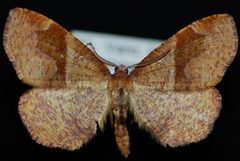
Plagodis pulveraria, commonly known as the barred umber, is a geometrid first described by Linnaeus in 1758. It is widely distributed across the from Ireland to Japan, with additional in Canada. The exhibits considerable color variation, ranging from reddish-brown to violaceous grey, with diagnostic straight antemedian and incurved postmedian lines on the forewings. are active in two from mid-spring through summer.
Pronunciation
How to pronounce Plagodis pulveraria: /ˈplæɡoʊdɪs ˌpʊlvəˈrɛəriə/
These audio files are automatically generated. While they are not always 100% accurate, they are a good starting point.
Identification
Distinguished from similar Plagodis and other geometrid moths by combination of: (1) relatively straight antemedian line on forewing, (2) strongly incurved postmedian line creating curved boundary to area, (3) consistent reddish-brown ground coloration regardless of variant, and (4) small, rounded wing shape. The incurved postmedian line is particularly diagnostic—most similar species show straighter or differently curved postmedian lines. Color variants can be confused with other reddish geometrids, but line pattern remains consistent. Smaller size and rounder wings separate it from larger, more angular Plagodis species.
Images
Appearance
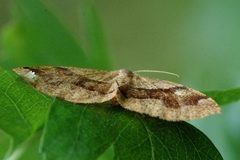
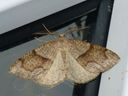
Small to medium-sized with wingspan 28–33 mm and forewing length 17–19 mm. Ground color variable but consistently showing reddish tones, ranging from brown to violaceous grey or purple-tinged in some forms. Forewings marked by relatively straight antemedian line and posteriorly strongly incurved postmedian line; area often darkened. Hindwings generally plainer with lines less pronounced. Wings relatively small and rounded. Several named color variants described, including violaceous grey (ab. passetii), deeper red with orange and purple tones (ab. marginepurpuraria), uniform brown without lines (ab. unicolor), and brighter yellow-brown (gadmensis).
Distribution
: Ireland across Europe to Japan; specifically recorded from Belgium, Netherlands, Switzerland (Gadmenthal), Russian Far East (Amurland), and Japan/Korea. : Canada. Exact preferences within these regions not documented in available sources.
Seasonality
fly in two from mid-March to August in Belgium and Netherlands; timing may vary across range. No specific data on in other parts of distribution.
Diet
Larval stage feeds on various deciduous trees including oak (Quercus), birch (Betula), and sallow (Salix). feeding habits not documented.
Host Associations
- Quercus - larval food plantdeciduous oak
- Betula - larval food plantbirch
- Salix - larval food plantsallow/willow
Life Cycle
(two per year) in at least part of range. Complete with , larva, pupa, and stages. Larval stage associated with deciduous trees. Specific details on site, stage, and developmental duration not documented.
Behavior
active during spring and summer months. No specific behavioral observations on mating, oviposition, or adult movement patterns documented in available sources.
Ecological Role
Larval herbivore on deciduous trees; contributes to nutrient cycling through leaf consumption. Specific ecological impacts or interactions not quantified.
Human Relevance
No documented economic importance. Subject of entomological interest due to color variation and wide distribution. 'barred umber' used in European recording schemes.
Similar Taxa
- Plagodis dolabrariaSimilar size and coloration, but has straighter postmedian line and more angular wing shape; area pattern differs
- Other reddish EnnominaeColor variants of P. pulveraria may resemble various brown geometrids, but diagnostic line pattern (straight antemedian, incurved postmedian) is distinctive
- Plagodis japonicaFormerly treated as or variant of P. pulveraria; now possibly distinct based on brighter red-brown color, broader area, and straighter hindwing line continuing to
More Details
Taxonomic complexity
The shows extensive color variation with multiple named forms (ab. passetii, ab. marginepurpuraria, ab. unicolor, gadmensis, violacearia, japonica). The Japanese/Korean (japonica) has been treated as both a color variant and a potentially distinct species due to consistent differences in coloration and wing pattern.
Flight season caveat
Documented pattern with mid-March to August period refers specifically to Belgium and Netherlands; likely varies with latitude and climate across the wide geographic range.