
Stathmopoda
Herrich-Schäffer, 1853
Species Guides
2- Stathmopoda aenea
- Stathmopoda elyella(Golden Stathmopoda)
Stathmopoda is a of small in the Stathmopodidae (or Stathmopodinae within Oecophoridae, depending on classification system). The genus exhibits diverse larval feeding habits: some are seed, fruit, or bud borers of angiosperms, including significant agricultural pests, while others are specialized fern spore feeders. The genus has a broad geographic distribution including Asia, Europe, and New Zealand, with particularly high documented in China.
Pronunciation
How to pronounce Stathmopoda: /stæθmoʊˈpoʊdə/
These audio files are automatically generated. While they are not always 100% accurate, they are a good starting point.
Identification
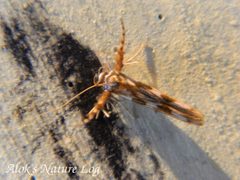
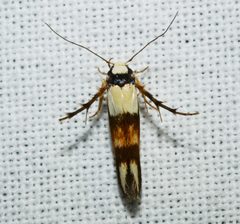
Distinguished from similar gelechioid moths by combination of wings, metallic-lustered smooth , curved sharp-tipped labial palps with subequal second and third segments, and dense hind leg tibial tufts. The spiniform setae on abdominal tergites and specific genitalic structures (bell-shaped uncus in males, signate corpus bursae in females) provide definitive characters. Within Stathmopodidae, identification requires examination of genitalia and wing pattern details.
Images
Habitat
Diverse reflecting varied associations: orchards and agricultural areas for fruit-feeding pest ; forested and natural areas for fern-associated species. Specific habitat varies by species and host plant availability.
Distribution
Broadly distributed across Asia (China, Japan, India, Taiwan, Réunion), Europe (Denmark, Norway, Sweden), and New Zealand. High in China with numerous recently described . Distribution closely tied to presence of plants, whether agricultural crops or native ferns.
Seasonality
Varies by and region. Stathmopoda masinissa in Japan shows pattern with two per year, mainly around sunset. Stathmopoda aposema in New Zealand has of 10-21 weeks at 18-20°C under laboratory conditions. Female calling in S. masinissa temperature-dependent, not observed below 14°C.
Diet
Larvae exhibit two distinct feeding strategies: (1) boring into seeds, fruits, or buds of angiosperms; (2) specialized feeding on fern spores. The latter represents an unusual dietary specialization within Lepidoptera.
Host Associations
- Amauropelta linkiana - original for fern spore-feeding Stathmopoda sp.
- Amauropelta rudis - experimental larvae can complete development but with reduced
- Amauropelta oligocarpa - experimental larvae can complete development but with reduced
- Amauropelta resinifera - experimental larvae can complete development but with reduced
- Macrothelypteris torresiana - experimental fern , larvae can complete development but with reduced
- Pyrrosia - multiple identified as for S. tacita larvae
- apple - of S. auriferella
- avocado - of S. auriferella
- grape - of S. auriferella
- jujube - of S. auriferella
- kiwifruit - of S. auriferella
- peach - of S. auriferella
- pomegranate - of S. auriferella
- persimmon - of S. masinissa, causing serious damage
Life Cycle
Complete with , larva, pupa, and stages. Some (two per year). Larval development includes multiple instars; fern-feeding species may skip fifth instar when on suboptimal . Prepupal induced by and temperature in some species; at 18°C critical day length between 15-16 hours for S. aposema. Diapause termination attempts unsuccessful in laboratory studies. Development time from egg to adult 10-21 weeks at 18-20°C under controlled conditions.
Behavior
Mating studied in S. masinissa: mainly at sunset, mating during twilight before sunrise. Females exhibit calling behavior beginning night of emergence, reaching peak rates one day after emergence in first (~70%) but lower in second generation (~35%). Both sexes typically mate once. Female calling temperature-dependent (absent below 14°C) and wind-sensitive (no trap attraction at 2.0 m/sec). Males attracted to females over distances of at least 20m. Prepupal shows long-day/short-day response pattern with temperature-modified critical day length.
Ecological Role
Larvae function as seed, fruit, and bud borers or specialized fern spore feeders. Some significant agricultural pests causing economic damage to fruits. Fern-feeding species represent rare example of spore-feeding specialization among Lepidoptera, contributing to nutrient cycling in fern . Role in fern-insect and specialization dynamics.
Human Relevance
Several are agricultural pests. Stathmopoda auriferella damages multiple fruit and vegetable crops including apples, avocados, grapes, jujubes, kiwifruit, peaches, and pomegranates. Stathmopoda masinissa causes serious damage to persimmons in orchards. Management requires monitoring of and female calling for timing of control measures.
Similar Taxa
- CalicotisFormerly included Stathmopoda attiei, now transferred to Calicotis; distinguished by morphological features of wings and genitalia
- Cyprininae (subfamily within Stathmopodidae)Specialized fern spore-feeding ; Stathmopoda includes fern-feeders but not exclusively, and lacks the defining subfamily characteristics
Misconceptions
placement has been disputed: variously placed in Stathmopodidae or as Stathmopodinae within Oecophoridae. This reflects ongoing uncertainty in gelechoid rather than error in identification.
More Details
Taxonomic Uncertainty
The and of gelechoid remain incompletely resolved, affecting -level placement of Stathmopoda. Current sources variously recognize Stathmopodidae as distinct family or as within Oecophoridae.
Fern Spore Feeding Specialization
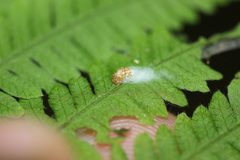
Stathmopodidae contains the highest of fern-spore-feeding Lepidoptera, though this habit is not restricted to the specialized Cyprininae. Stathmopoda tacita, rediscovered after more than 100 years without records, exemplifies this unusual . Larval to specific fern is strong: experimental host switching results in reduced survival, extended development time, and higher spore consumption, suggesting chemical or nutritional barriers to host expansion.
Diapause Physiology
Stathmopoda aposema shows complex induction with temperature-dependent critical day length. At 18°C, critical day length is 15-16 hours; at 20°C, it shifts to less than 12 hours. Minimum diapause occurs at 16 hours day length regardless of temperature, but optimal temperature for low diapause (~23°C) produces infertile insects at 22°C, indicating trade-offs in environmental response.
Sources and further reading
- BugGuide
- Wikipedia
- GBIF taxonomy match
- iNaturalist taxon
- NCBI Taxonomy
- Catalogue of Life
- Mating behavior of the persimmon fruit moth, Stathmopoda masinissa Meyrick (Lepidoptera: Stathmopodidae)
- Genus Stathmopoda Herrich-Schäffer, 1853 (Lepidoptera: Stathmopodidae) from China: Descriptions of thirteen new species
- Genus Stathmopoda Herrich-Schäffer, 1853 (Lepidoptera: Stathmopodidae) from China: Descriptions of ten new species
- Genus Stathmopoda Herrich-Schäffer, 1853 (Lepidoptera: Stathmopodidae) from China (III): Descriptions of fourteen new species
- Two New Records of Genus <i>Stathmopoda</i> Herrich-Shaffer [1853] (Stathmopodidae: Lepidoptera) from Karnataka
- Figure 2 from: Shen Z-Y, Hsu Y-F (2023) Rediscovering a species not seen for a hundred years, Stathmopoda tacita (Meyrick, 1913) (Lepidoptera, Stathmopodidae), with its unusual fern-spore-feeding life history. Biodiversity Data Journal 11: e101468. https://doi.org/10.3897/BDJ.11.e101468
- Rediscovering a species not seen for a hundred years, Stathmopoda tacita (Meyrick, 1913) (Lepidoptera, Stathmopodidae), with its unusual fern-spore-feeding life history
- Mating Behavior and Male Response to Female Abdominal Extracts in the Persimmon Fruit Moth, Stathmopoda masinissa(Lepidoptera: Oecophoridae).
- Rearing and the effects of photoperiod and temperature on diapause in Stathmopoda aposema (Lepidoptera: Oecophoridae: Stathmopodinae)
- Figure 1 from: Shen Z-Y, Hsu Y-F (2023) Rediscovering a species not seen for a hundred years, Stathmopoda tacita (Meyrick, 1913) (Lepidoptera, Stathmopodidae), with its unusual fern-spore-feeding life history. Biodiversity Data Journal 11: e101468. https://doi.org/10.3897/BDJ.11.e101468
- Effects of experimental host‐plant switching on the life cycle of a fern spore‐feeding micromoth of the genus Stathmopoda