
Stathmopodidae
Meyrick, 1913
Feather-legged Moths
Genus Guides
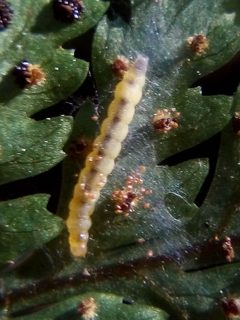
1Stathmopodidae is a of small in the superfamily Gelechioidea, established by Edward Meyrick in 1913. The family exhibits remarkable ecological diversity, with larvae displaying varied feeding habits including , carnivory, and specialized fern-spore feeding. The Cyprininae is specifically adapted to fern-spore consumption. The Stathmopoda is the most -rich genus, with significant diversity in India and China.
Pronunciation
How to pronounce Stathmopodidae: //stæθmoʊˈpɒdɪdiː//
These audio files are automatically generated. While they are not always 100% accurate, they are a good starting point.
Identification
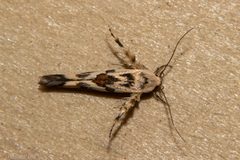
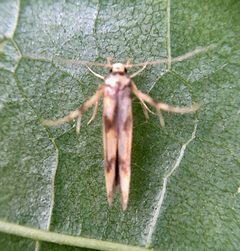
Members of Stathmopodidae are small typically characterized by distinctive leg , including feathered or scaled legs that contribute to their . Accurate identification to and level generally requires examination of genitalia characters and detailed wing venation patterns.
Images
Distribution
Stathmopodidae has a broad geographic distribution across Asia, with documented records from India (53 in 10 ), China (numerous species with ongoing taxonomic work), Taiwan, Korea, and Japan. The has also been recorded in Europe (Denmark, Norway, Sweden). Meghalaya state in India exhibits the highest diversity with 6 genera and 19 species.
Diet
Larvae exhibit diverse feeding strategies: consumption of fern spores (documented in Cyprininae, Pachyrhabda, and Stathmopoda tacita), feeding on various plant , on soft-bodied insects, and consumption of dried products. Some species feed on specific fern including Pyrrosia species (Polypodiaceae), Microsorum brachylepis, and Tectaria species.
Host Associations
- Pyrrosia (Polypodiaceae) - larval for Stathmopoda tacita larvae
- Microsorum brachylepis - larval for Cuprina atayalica
- Tectaria subtriphylla - larval for Cuprina insolita
- Tectaria harlandii - larval for Cuprina insolita
Life Cycle
At least some exhibit with distinct first and second showing different behavioral patterns. In Stathmopoda masinissa, occurs mainly around sunset.
Behavior
Female calling in Stathmopoda masinissa begins on the night of and peaks at approximately 70% one day after emergence in first . Calling and mating occur during twilight before sunrise. Males are attracted to virgin female traps from distances up to 20 meters. Calling behavior is temperature-dependent, not observed below 14°C.
Ecological Role
Fern-spore-feeding members represent a specialized ecological guild, as fern-spore consumption is rare among Lepidoptera. The contributes to nutrient cycling through detritivory on dried products and serves as a link between fern and higher .
Human Relevance
Some are associated with agricultural systems: Stathmopoda masinissa is known as the persimmon fruit . The broad ecological diversity of the , ranging from plant-feeding to species, makes it significant for studies of dietary evolution in Lepidoptera.
Similar Taxa
- Other Gelechioidea familiesStathmopodidae can be distinguished by characteristic leg and specific genitalia structures; precise differentiation requires detailed morphological examination
More Details
Fern-spore feeding specialization
Stathmopodidae contains the highest of fern-spore-feeding Lepidoptera, with the Cyprininae Sinev, 2015 specifically specialized on this habit. However, fern-spore feeding also occurs outside this subfamily, indicating multiple evolutionary origins of this trait within the .
Taxonomic activity
The is subject to active taxonomic research, with numerous new described from China in recent years (27+ new Stathmopoda species described 2019-2021) and ongoing documentation of associations and .
Sources and further reading
- BugGuide
- Wikipedia
- GBIF taxonomy match
- iNaturalist taxon
- NCBI Taxonomy
- Catalogue of Life
- A catalogue of Indian Stathmopodidae (Lepidoptera: Gelechioidea)
- Mating behavior of the persimmon fruit moth, Stathmopoda masinissa Meyrick (Lepidoptera: Stathmopodidae)
- Calicotis Meyrick (Lepidoptera: Stathmopodidae) new to China, with descriptions of three new species
- A new species of Pachyrhabda Meyrick (Lepidoptera: Stathmopodidae) from the Korean Peninsula
- Genus Stathmopoda Herrich-Schäffer, 1853 (Lepidoptera: Stathmopodidae) from China (III): Descriptions of fourteen new species
- Genus Stathmopoda Herrich-Schäffer, 1853 (Lepidoptera: Stathmopodidae) from China: Descriptions of ten new species
- Genus Stathmopoda Herrich-Schäffer, 1853 (Lepidoptera: Stathmopodidae) from China: Descriptions of thirteen new species
- Newly-recorded species of the genus Atkinsonia Stainton, 1859 (Lepidoptera, Stathmopodidae) from Korea with checklist
- The fern-feeding genus Cuprina Sinev, 1988 (Lepidoptera, Stathmopodidae), new for Taiwan, with descriptions of two new species
- Rediscovering a species not seen for a hundred years, Stathmopoda tacita (Meyrick, 1913) (Lepidoptera, Stathmopodidae), with its unusual fern-spore-feeding life history
- Two New Records of Genus <i>Stathmopoda</i> Herrich-Shaffer [1853] (Stathmopodidae: Lepidoptera) from Karnataka
- Rediscovery of the mysterious Taiwanese micromoth Pachyrhabda citrinacma Meyrick, 1936 (Stathmopodidae) in museum and field, with notes on the fern-spore feeding larva