
Batia lunaris
Haworth, 1828
Lesser Tawny Crescent
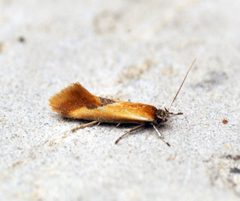
Batia lunaris, commonly known as the Lesser Tawny Crescent, is a small gelechioid in the Oecophoridae. It is the type of Batia. are and fly in mid-summer, with a wingspan of 7–10 mm. The species is widespread across European woodlands.
Pronunciation
How to pronounce Batia lunaris: /ˈbeɪtɪə luːˈnɛərɪs/
These audio files are automatically generated. While they are not always 100% accurate, they are a good starting point.
Identification
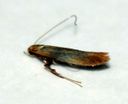
Distinguished from the closely related Batia lambdella by smaller size (approximately two-thirds). The dark blotch at the margin of the forewing, which forms a continuous pointed patch when wings are laid back, is a key field mark. Forewings are yellow with orange towards the dorsum, with ferruginous and termen, and a narrow fuscous costal streak from base to two-thirds.
Images
Appearance
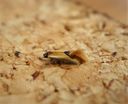
Small with wingspan 7–10 mm. Forewings dark ochre, slightly darker at tips, with hairy fringe. A dark blotch at the margin at the border between light and dark areas forms a continuous pointed patch when wings are laid back at rest. whitish mixed with dark fuscous. Hindwings ovate-, rather dark grey.
Habitat
Woodlands across Europe. Specific microhabitat preferences for larvae are insufficiently known, but related inhabit areas under bark.
Distribution
Europe, including widespread occurrence in England and Belgium. Present in Flemish Region, Walloon Region, and Brussels-Capital Region of Belgium.
Seasonality
fly in July and August, with timing varying by location.
Life Cycle
Complete with , larva, pupa, and stages. Larval habits are not sufficiently known.
Behavior
. are attracted to bright lights.
Similar Taxa
- Batia lambdellaLarger size (approximately 1.5× the wingspan); otherwise very similar in appearance
More Details
Taxonomic status
Type of Batia. The genus is sometimes treated as , but this is not well warranted as other species placed in Batia differ little from B. lunaris.