
Mompha sturnipennella
(Treitschke, 1833)
Kentish Cosmet
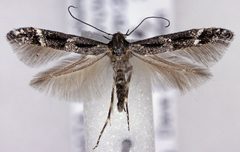
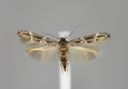
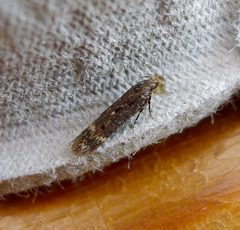
Mompha sturnipennella is a small gelechioid in the Momphidae, with a wingspan of 13–18 mm. It exhibits a pattern, with one active in July–August and a second generation emerging in September, , and flying until May. The is widely distributed across the Holarctic, occurring throughout most of Europe (excluding the Mediterranean south), Siberia, the Russian Far East, and Canada.
Pronunciation
How to pronounce Mompha sturnipennella: //ˈmɒmfə ˌstɜrnɪˈpɛnɛlə//
These audio files are automatically generated. While they are not always 100% accurate, they are a good starting point.
Identification
Distinguished from other Mompha by its combination of size (13–18 mm wingspan), with autumn-spring hibernation, and association with rosebay willowherb (Chamaenerion angustifolium) as larval . The specific epithet 'sturnipennella' refers to starling-like (sturnus) wing shape. Similar species in the Mompha require dissection or rearing to confirm identification.
Images
Habitat
Associated with stands of rosebay willowherb (Chamaenerion angustifolium), its obligate larval . Occurs in open , disturbed ground, woodland clearings, and other environments where the host plant grows.
Distribution
Holarctic distribution: most of Europe (absent from the Mediterranean south), extending east through Siberia and the Russian Far East, and present in Canada.
Seasonality
active July–August (first ) and September–May following hibernation (second generation). Larvae of first generation present May–June; second generation larvae July–August.
Diet
Larvae are stem-borers in rosebay willowherb (Chamaenerion angustifolium), feeding internally within stems and flowering parts. Second larvae develop within seedpods. feeding habits not documented.
Host Associations
- Chamaenerion angustifolium - larval rosebay willowherb; larvae bore in stems and seedpods
Life Cycle
with two larval per year. First generation larvae develop May–June in stems; second generation larvae develop July–August, typically in seedpods. occurs within the plant. of second generation enter hibernation until spring.
Behavior
Larvae feed internally within plant tissues, inducing gall formation in stems. of the second undergo extended hibernation from autumn through spring.
Ecological Role
As a stem-borer, larvae modify plant tissue and induce gall formation, potentially affecting seed production in rosebay willowherb. Specific ecological impacts on host not quantified.
Human Relevance
No documented economic or medical significance. Occasionally encountered by naturalists and recorders. Scientific interest as a model for studying plant-insect interactions and gall induction.
Similar Taxa
- Other Mompha speciesMany Mompha share small size and similar wing patterns; reliable identification requires examination of genitalia or rearing from known plants.
More Details
Nomenclature
Originally described as Ornix sturnipennella by Treitschke in 1833; later transferred to Mompha.