
Gnorimoschema baccharisella
Busck, 1903
Coyote Brush Stem Gall Moth
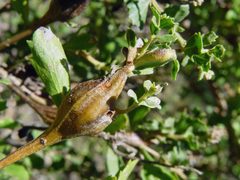
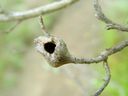
Gnorimoschema baccharisella is a small in the Gelechiidae, first described by August Busck in 1903. It is found in California, where its larvae induce hard stem galls on Baccharis pilularis (coyote brush). The exhibits in forewing size, with females being slightly larger than males.

Pronunciation
How to pronounce Gnorimoschema baccharisella: //ŋoʊˌraɪmoʊˈskiːmə ˌbækəˈrɪsɛlə//
These audio files are automatically generated. While they are not always 100% accurate, they are a good starting point.
Identification
Distinguished from other Gnorimoschema by its association with Baccharis pilularis galls and its known California distribution. The hard stem galls it produces on coyote brush are characteristic; other Gnorimoschema species induce galls on different plants (e.g., G. gallaesolidaginis on goldenrod, G. debenedictisi on an unknown host). specimens require genitalia examination or molecular analysis for definitive identification.
Images
Appearance
Forewings measure 6.2–8.5 mm in males and 6.5–9 mm in females. As a gelechiid , it likely has narrow, forewings with relatively simple patterning typical of the , though specific coloration details are not documented in available sources.
Habitat
Associated with coastal and interior scrub where the plant Baccharis pilularis (coyote brush) occurs. This includes coastal dunes, coastal scrub, chaparral edges, and disturbed open areas in California.
Distribution
Recorded only from California, United States. Distribution corresponds to the range of its plant Baccharis pilularis, which is to California and Oregon.
Seasonality
are active from mid-July to late November, with peak activity likely in late summer and fall.
Diet
Larvae feed on Baccharis pilularis (coyote brush), inducing hard stem galls. feeding habits are not documented.
Host Associations
- Baccharis pilularis - larval plantLarvae induce hard stem galls on this plant; occurs on the ground
Life Cycle
are deposited on Baccharis pilularis. Larvae feed within stems, inducing hard galls. takes place on the ground, outside the gall. emerge from mid-July through late November.
Behavior
are and likely attracted to light, as is common for gelechiid moths. Larvae are endophagous, feeding internally within stem galls.
Ecological Role
As a gall inducer, the manipulates plant growth to create a protected feeding chamber. The galls may serve as microhabitats for other organisms, though specific or are not documented. The relationship exemplifies the gall-forming habit found in numerous Gnorimoschema species.
Human Relevance
May be encountered by botanists and land managers monitoring Baccharis pilularis . The has no documented economic impact. Related research on gall-forming Gnorimoschema species (particularly G. gallaesolidaginis) has explored using insect-induced galls as bioindicators for soil contaminants, though this specific application has not been tested for G. baccharisella.
Similar Taxa
- Gnorimoschema gallaesolidaginisAlso a stem gall inducer, but on goldenrod (Solidago) rather than Baccharis; produces elongate galls rather than hard stem galls
- Gnorimoschema debenedictisiNamed for John De Benedictis, who discovered it on San Bruno Mountain; plant unknown but likely distinct from B. pilularis
- Other Baccharis-feeding insectsSeveral other insects feed on Baccharis pilularis, including other gall midges and , but G. baccharisella is distinguished by its specific hard stem gall
More Details
Taxonomic history
Described by August Busck in 1903, a prominent early American lepidopterist who described numerous North American microlepidoptera.
Research potential
Given recent research demonstrating that insect-induced galls can accumulate environmental contaminants at higher concentrations than surrounding plant tissues, G. baccharisella galls on the widespread B. pilularis could potentially serve as bioindicators for pollution monitoring in California coastal , though this has not been specifically investigated.
Sources and further reading
- BugGuide
- Wikipedia
- GBIF taxonomy match
- iNaturalist taxon
- NCBI Taxonomy
- Catalogue of Life
- Blacklighting at the Bohart: They Saw the Light | Bug Squad
- Meet 'The Moth Man' at Bohart Museum's Moth Night | Bug Squad
- Gnorimoschema gallaesolidaginis Archives - Entomology Today
- How Some Insects Turn Plants Into Pollution Detectors
- goldenrod gall - Entomology Today