
Chrysoesthia sexguttella
(Thunberg, 1794)
Orache Leafminer Moth
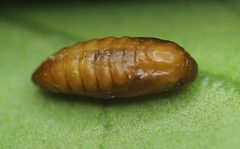
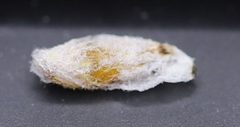
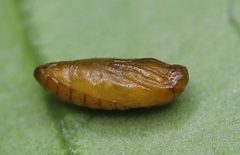
Chrysoesthia sexguttella is a small gelechiid known as the orache leafminer moth. are active in two per year, flying in spring (May–June) and late summer (August–September). The larvae are specialized leaf miners that feed internally on leaves of Chenopodium, Atriplex, and related plants in Amaranthaceae, creating distinctive contorted gallery mines. The is widespread across Europe and Asia, with introduced in northeastern North America.
Pronunciation
How to pronounce Chrysoesthia sexguttella: /ˌkrɪsoʊˈɛsθiə ˌsɛksɡʌˈtɛlə/
These audio files are automatically generated. While they are not always 100% accurate, they are a good starting point.
Identification
Distinguished from other small gelechiids by the combination of metallic brassy-grey and the distinctive yellow spotting pattern on dark forewings: a larger spot and smaller discal spot. The leaf mines are diagnostic: contorted, gallery-forming mines on the surface of Chenopodium and Atriplex leaves, often with visible trails. Similar Chrysoesthia may differ in spot configuration and plant associations.
Images
Habitat
Open, disturbed including fields, gardens, roadsides, and coastal areas where plants grow. Associated with weedy Chenopodium and Atriplex vegetation. Larval habitat is within the leaf tissue of host plants.
Distribution
Native to Europe, ranging east to southern Siberia. Introduced and established in northeastern North America (possibly non-native there). Recorded from Belgium at multiple administrative levels.
Seasonality
: active May–June and August–September. Two per year in temperate regions.
Diet
Larva feeds as a on leaves of Atriplex (including A. patula, A. prostrata, A. littoralis, A. hortensis, A. hastata, A. nitens, A. sibirica, A. cakotheca), Chenopodium species (including C. album, C. bonus-henricus, C. giganteum, C. glaucum, C. hybridum, C. murale, C. opulifolium, C. polyspermum, C. quinoa, C. urbicum, C. vulvaria), Amaranthus blitum, Amaranthus caudatus, Bassia scoparia, and Spinacia.
Host Associations
- Atriplex patula - food plantlarval leaf mine
- Atriplex prostrata - food plantlarval leaf mine
- Atriplex littoralis - food plantlarval leaf mine
- Atriplex hortensis - food plantlarval leaf mine
- Atriplex hastata - food plantlarval leaf mine
- Atriplex nitens - food plantlarval leaf mine
- Atriplex sibirica - food plantlarval leaf mine
- Atriplex cakotheca - food plantlarval leaf mine
- Chenopodium album - food plantprimary larval , leaf mines
- Chenopodium bonus-henricus - food plantlarval leaf mine
- Chenopodium giganteum - food plantlarval leaf mine
- Chenopodium glaucum - food plantlarval leaf mine
- Chenopodium hybridum - food plantlarval leaf mine
- Chenopodium murale - food plantlarval leaf mine
- Chenopodium opulifolium - food plantlarval leaf mine
- Chenopodium polyspermum - food plantlarval leaf mine
- Chenopodium quinoa - food plantlarval leaf mine
- Chenopodium urbicum - food plantlarval leaf mine
- Chenopodium vulvaria - food plantlarval leaf mine
- Amaranthus blitum - food plantlarval leaf mine
- Amaranthus caudatus - food plantlarval leaf mine
- Bassia scoparia - food plantlarval leaf mine
- Spinacia - food plantlarval leaf mine
- Pnigalio gyamiensis - larval-pupal ectoparasitoid; female paralyzes larva
- Pnigalio soemius - reared from this
- Pnigalio cristatus - reared from this
- Pnigalio incompletus - reared from this
- Pnigalio agraules - reared from this
Life Cycle
Two per year (). Larval development occurs through four instars inside leaf mines, followed by . In the Middle Volga region, first generation fly May–July, second generation August–September.
Behavior
Larvae form contorted, gallery-style leaf mines on the surface of plant leaves, with visible trails. When parasitized by Pnigalio gyamiensis, the host larva becomes paralyzed, loses mobility, stops feeding, and dies. The female shows no significant preference for laying on live versus dead host larvae.
Ecological Role
Herbivore and on weedy Amaranthaceae, particularly Chenopodium album. Serves as for multiple Pnigalio (P. gyamiensis, P. soemius, P. cristatus, P. incompletus, P. agraules), which may contribute to of this and related herbivores.
Human Relevance
Minor pest of spinach and quinoa . Presence in quinoa crops has been documented. Otherwise generally associated with weedy vegetation of limited agricultural concern.
Similar Taxa
- Other Chrysoesthia speciesSimilar size and metallic coloration; distinguished by precise configuration of forewing spots and plant associations
- Other small Gelechiidae leaf minersSimilar mining habit; distinguished by plant specificity and mine (contorted gallery on Chenopodium/Atriplex surface)
More Details
Parasitoid biology
Pnigalio gyamiensis is a documented larval-pupal ectoparasitoid. The female lays a single on or near the larva. Long body hairs on the newly hatched larva provide high mobility.
North American status
in northeastern North America may represent an introduced, non-native range expansion rather than native distribution.