
Chrysoesthia
Hübner, [1825]
Species Guides
3- Chrysoesthia drurella(Spinach moth)
- Chrysoesthia lingulacella(silver-banded moth)
- Chrysoesthia sexguttella(Orache Leafminer Moth)
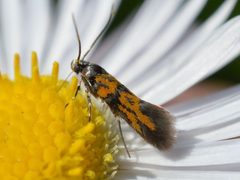
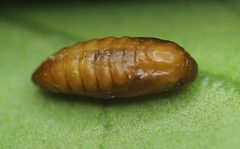
Chrysoesthia is a of small in the Gelechiidae, Anomologinae. The genus contains approximately 20 described distributed across the Northern Hemisphere. At least one species, Chrysoesthia sexguttella, is known to be a on Chenopodium album (Amaranthaceae). Larvae form mines inside leaves and serve as for in the family Eulophidae.
Pronunciation
How to pronounce Chrysoesthia: //ˌkraɪsoʊˈɛsθiə//
These audio files are automatically generated. While they are not always 100% accurate, they are a good starting point.
Images
Habitat
in this occupy environments where their plants grow. Chrysoesthia sexguttella has been observed in fields, gardens, and along roads and paths where Chenopodium album occurs.
Distribution
Records exist from Denmark, Norway, Sweden, the United States (including Vermont), Russia (Middle Volga Basin), Turkmenistan, and Italy. The appears to have a Holarctic distribution pattern.
Seasonality
Chrysoesthia sexguttella exhibits two per year in the Middle Volga region: May through July and August through September.
Diet
Larvae of at least Chrysoesthia sexguttella form leaf mines in Chenopodium album. Atriplex have also been referenced as food plants.
Host Associations
- Chenopodium album - food plantLarval ; leaf mines formed in leaves
- Atriplex sp. - food plantReferenced from type locality
- Pnigalio gyamiensis - Ectoparasitoid (Eulophidae) that attacks larvae inside leaf mines
Life Cycle
Chrysoesthia sexguttella completes two annually in the Middle Volga region. Larval development occurs inside leaf mines of the plant.
Behavior
Larvae are leaf miners, developing within the leaf tissue of plants. When parasitized by Pnigalio gyamiensis, host larvae become paralyzed, lose mobility, and cease feeding before death.
Ecological Role
Larvae function as leaf miners on Chenopodium album. The serves as a for , including Pnigalio gyamiensis.
More Details
Taxonomic History
The was established by Hübner in 1825. Recent additions include Chrysoesthia longifibriata and C. luteola described by Omelko & Omelko in 2010 from the Primorsky district of Russia.