
Bryotropha similis
(Stainton, 1854)
obscure neb
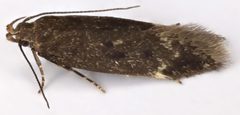
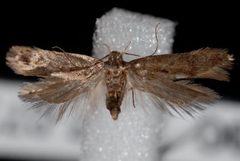
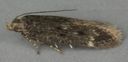
Bryotropha similis is a small gelechiid with a Holarctic distribution spanning northern Europe, Greenland, Iceland, and the Palaearctic region. The has a wingspan of 11–13 mm and exhibits distinctive wing patterning with dark fuscous forewings and faint pale markings. are active from early June to late August, likely in a single . The species is known from the iNaturalist as the 'obscure neb'.
Pronunciation
How to pronounce Bryotropha similis: /bɹaɪˈɒtɹəfə ˈsɪmɪlɪs/
These audio files are automatically generated. While they are not always 100% accurate, they are a good starting point.
Identification
Distinguished from by the relative length of palpal joints (terminal longer than second) and the position of the first discal stigma beyond the plical. The faint, angulated pale fascia at 3 creating an indistinct ochreous-whitish costal spot is also diagnostic. Similar within Bryotropha require examination of genitalia for definitive separation.
Images
Appearance
Small with wingspan of 11–13 mm. Terminal joint of palpi longer than second. Forewings dark fuscous, somewhat paler sprinkled; stigmata indistinctly blackish, with first discal beyond plical; faint slender obtusely angulated pale fascia at 3, forming indistinct ochreous-whitish spot on . Hindwings grey, paler anteriorly.
Habitat
preferences are not well documented in available sources. Based on distribution, occurs in northern and montane regions of Europe, suggesting for cooler climates. Southern European records are restricted to mountainous areas, indicating elevation-dependent distribution.
Distribution
Holarctic distribution including Greenland, Iceland, and widespread across northern, central, and eastern Europe. In southern Europe, restricted to few mountainous regions. Present throughout the Palaearctic region. Specific country records include Belgium (Antwerpen, Hainaut, Walloon Region).
Seasonality
recorded on wing from early June to late August. Probably (one per year), though this is not definitively established.
Life Cycle
Complete with , larval, pupal, and stages. Larval and plants are not documented in available sources. and stage unknown.
Similar Taxa
- Bryotropha senectellaSimilar size and general appearance; requires examination of genitalia and wing pattern details for separation
- Other Bryotropha species contains numerous small, dark gelechiids with subtle wing pattern differences; definitive identification often requires dissection
More Details
Taxonomic history
Originally described as Gelechia similis by Stainton in 1854, later transferred to Bryotropha. The has been consistently recognized in this combination since at least the mid-20th century.
iNaturalist observations
As of data compilation, 124 observations recorded on iNaturalist, indicating moderate detectability by naturalists in suitable .
Sources and further reading
- BugGuide
- Wikipedia
- GBIF taxonomy match
- iNaturalist taxon
- NCBI Taxonomy
- Catalogue of Life
- Encyrtid Holdings | Entomology Research Museum
- Bug Eric: A Jumping Spider, Tutelina similis
- Study Shows American Dog Ticks in Western U.S. Are a Separate Species
- Bug Eric: Moth Monday: Palo Verde Webworm
- new species | Blog - Part 3