
Anarsia lineatella
Zeller, 1839
Peach twig borer, Almond fruit moth
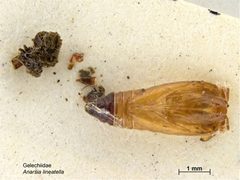
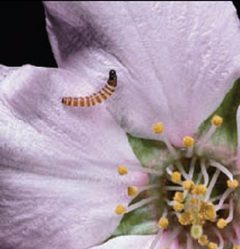
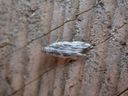
Anarsia lineatella, commonly known as the peach , is a gelechiid native to Europe that was introduced to California in the 1880s and has since spread to other regions. It is a significant agricultural pest of stone fruits, particularly peach, almond, plum, and apricot. The exhibits multivoltine with two to three per year in most regions, with development rates varying by climate. are small moths with a wingspan of 11–14 mm. The species overwinters as second or third instar larvae within buds and bark cracks, with termination synchronized by winter chilling.
Pronunciation
How to pronounce Anarsia lineatella: /ænˈɑːr.si.ə ˌlɪ.niː.əˈtɛl.ə/
These audio files are automatically generated. While they are not always 100% accurate, they are a good starting point.
Identification
Wingspan 11–14 mm. Distinguished from similar gelechiid moths by association with Prunus and by geographic origin in regions where it occurs as an introduced pest. Males are attracted to traps baited with synthetic or females, which can aid in detection and monitoring.
Images
Habitat
Agricultural landscapes dominated by stone fruit orchards, particularly peach, almond, plum, and apricot. In heterogeneous agricultural landscapes, highest densities occur in stone fruit orchards, with additional presence in plum orchards. Distribution within landscapes is influenced by plant location and male movement patterns between breeding and mating sites.
Distribution
Native to Europe, with documented occurrence in Austria, Belgium, Bulgaria, Crete, France, Germany, Greece, Hungary, Italy, Malta, Poland, Spain, Sweden, Switzerland, and former Yugoslavia. Introduced to North America (California in the 1880s, subsequently spreading; also Canada and USA broadly). Present in Asia including China, Cyprus, Iraq, Israel, Kashmir, Lebanon, Pakistan, Persia, Syria, Turkey, and former USSR territories. Also recorded in North Africa (Algeria, Egypt, Libya, Morocco, Tunisia).
Seasonality
period varies by region. In southern Ukraine, flight begins May 6–18 and continues until September 18–30 (134–141 days), with three peaks: late May, late June–early July, and late July–mid August. In general European references, on wing from June to August depending on location. Highest flight intensity occurs during July–August at high temperatures (25.0–26.9°C).
Diet
Larvae feed on Prunus including Prunus avium (sweet cherry), Prunus spinosa (blackthorn), Prunus domestica (plum), Prunus insititia (damson), and Prunus persica (peach). In California, significant pest of almond (Prunus dulcis) plantations. Larval development from to pupa takes 15–27 days.
Host Associations
- Prunus avium - larval food plantsweet cherry
- Prunus spinosa - larval food plantblackthorn
- Prunus domestica - larval food plantplum
- Prunus insititia - larval food plantdamson
- Prunus persica - larval food plantpeach; primary
- Prunus dulcis - larval food plantalmond; major pest in California
Life Cycle
Overwinters as second or third instar larva within buds and bark cracks. is weak; larvae may complete diapause development by late January but show synchronized termination in early February after essential chilling. Cold storage at 4°C for 30+ days synchronizes reactivation, with 45–60 days chilling significantly shortening developmental time. In southern Ukraine, caterpillar feeding restoration begins late March–mid April, with late April–early May. begins May 6–18 (accumulated effective temperatures >8°C: 154.5–254.3 ). First duration 44–50 days; subsequent generations 30–40 days. Two full generations develop per year with third generation caterpillars completing development the following spring. Accumulated effective temperatures >8°C from to imago range 436.5–743.0 degree-days.
Behavior
Sexual communication exhibits diel periodicity with peak activity in pre-dawn to early morning hours. Under laboratory conditions (16L:8D ), females emit primarily 0400–0600 Pacific Standard Time, though pheromone is present in glands throughout the 24-hour period. Field studies confirm male attraction to pheromone occurs 0300–0600, indicating temporal overlap between female emission and male response. Females reduce pheromone emission when males are physically present but separated, indicating males signal their presence and females modulate signaling accordingly. Oviposition site selection is influenced by fruit maturity and surface characteristics: females prefer green and mature green peach fruits over soft-ripe fruits, and fuzzy peach surfaces receive ten times more than shaved hairless surfaces. Volatiles from almond and peach shoots and fruits stimulate oviposition.
Ecological Role
Agricultural pest causing yield losses up to 30–40% in almond orchards through damage to seed parts of fruits. are influenced by meteorological factors and rates of previous . Spatial distribution in agricultural landscapes is determined primarily by plant location and male movement patterns.
Human Relevance
Major economic pest of stone fruit and almond production. relies on trapping for monitoring, with knowledge of spatial distribution patterns and temporal dynamics essential for farming approaches. spray applications target larvae.
Similar Taxa
- Grapholita molestaCo-occurs in stone fruit orchards and shares similar and trapping detection methods; distinguished by different spatio-temporal distribution patterns and preferences within the same agricultural landscape
Sources and further reading
- BugGuide
- Wikipedia
- GBIF taxonomy match
- iNaturalist taxon
- NCBI Taxonomy
- Catalogue of Life
- Anarsia lineatella . [Distribution map].
- Biophenology peach twig borer (Anarsia lineatella Zell.) in the south of Ukraine
- Diel periodicity of sexual communication in Anarsia lineatella (Lepidoptera: Gelechiidae)
- The Almond Fruit Moth (Anarsia lineatella Zeller) Spread in Almond Orchards of Azerbaijan and its Bioecological Characteristics
- STUDIES ON THE BIOLOGY AND THE ECOLOGICAL PECULIARITIES OF ANARSIA LINEATELLA ZELL IN THE REGION OF SILISTRA
- ON THE ECOLOGY OF THE PEACH TWIG BORER, ANARSIA LINEATELLA (ZELLER) ON APRICOT TREES AT KALUBIA GOVERNORATE, EGYPT
- THE RESPONSE OF PEACH TWIG BORER (ANARSIA LINEATELLA), SAN JOSE SCALE (QUADRASPIDIOTUS PERNICIOSUS) AND THE SCALE PARASITOID ENCARSIA PERNICIOSI TO DORMANT SPRAYS IN ALMOND
- Synchronized diapause termination of the peach twig borer Anarsia lineatella (Lepidoptera: Gelechiidae): Brownian motion with drift?
- Geostatistical characterization of the spatial distribution of Grapholita molesta and Anarsia lineatella males in an agricultural landscape
- Stimuli affecting selection of oviposition sites by female peach twig borer, Anarsia lineatella Zeller (Lepidoptera: Gelechiidae)