Rectiostoma xanthobasis
(Zeller, 1876)
Yellow-vested Moth
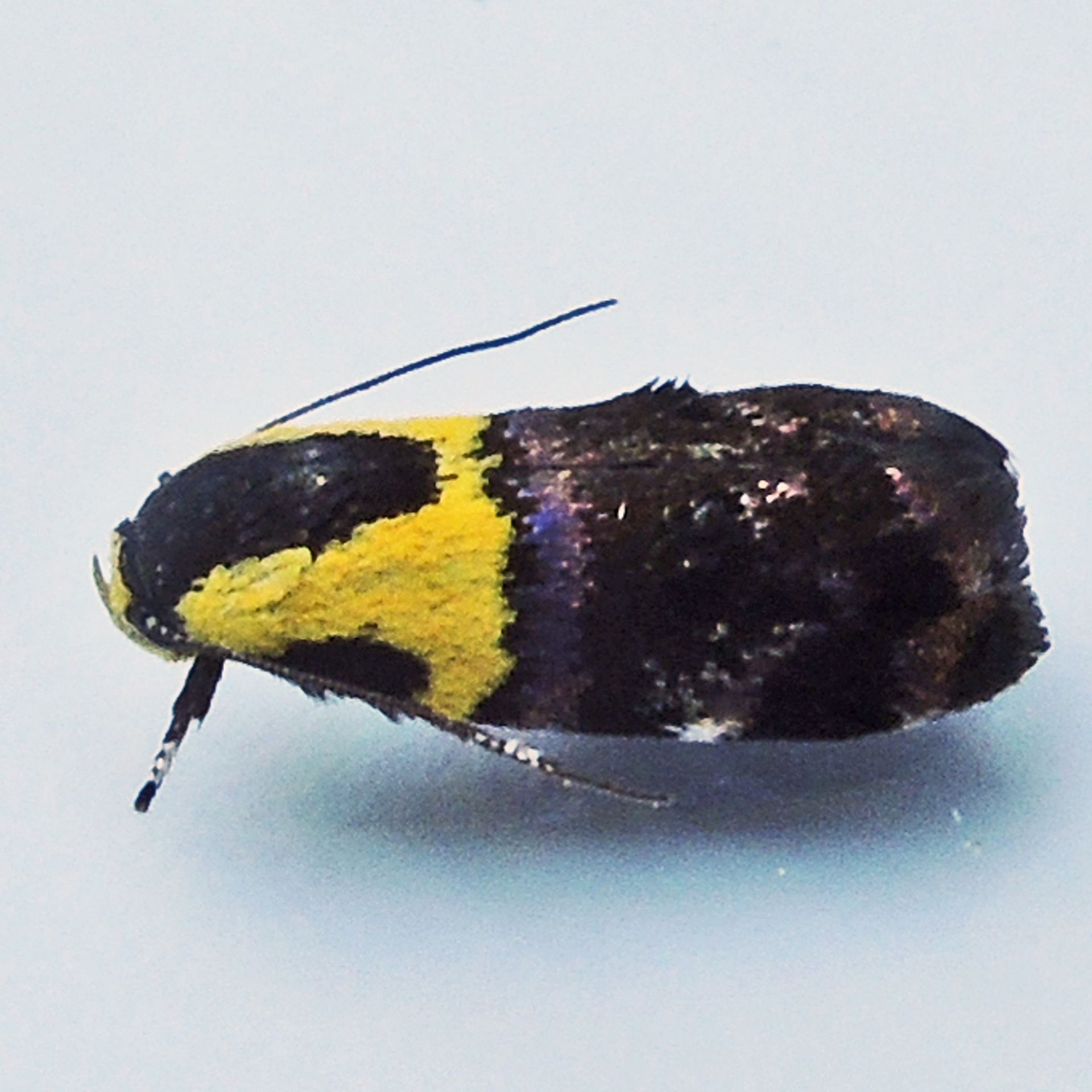
Rectiostoma xanthobasis is a small in the Depressariidae, described by Philipp Christoph Zeller in 1876. It is distinguished by striking yellow and dark brown wing patterning that gives rise to its . The is to eastern North America, with larvae that feed on oak leaves from within silk-constructed shelters.
Pronunciation
How to pronounce Rectiostoma xanthobasis: //ˌrɛk.tiˈɒ.stə.mə ˌzæn.θoʊˈbeɪ.sɪs//
These audio files are automatically generated. While they are not always 100% accurate, they are a good starting point.
Identification
Distinguished from other Rectiostoma by the combination of lemon yellow basal area on forewings continuous with yellow tegula, iridescent blue-violet submarginal band, and specific pattern of dark spots within the yellow basal area. The white hindwing patch on the margin is also diagnostic. Similar dark brown and yellow patterned in related lack the precise configuration of white costal patches and blue-violet iridescence.
Images
Appearance
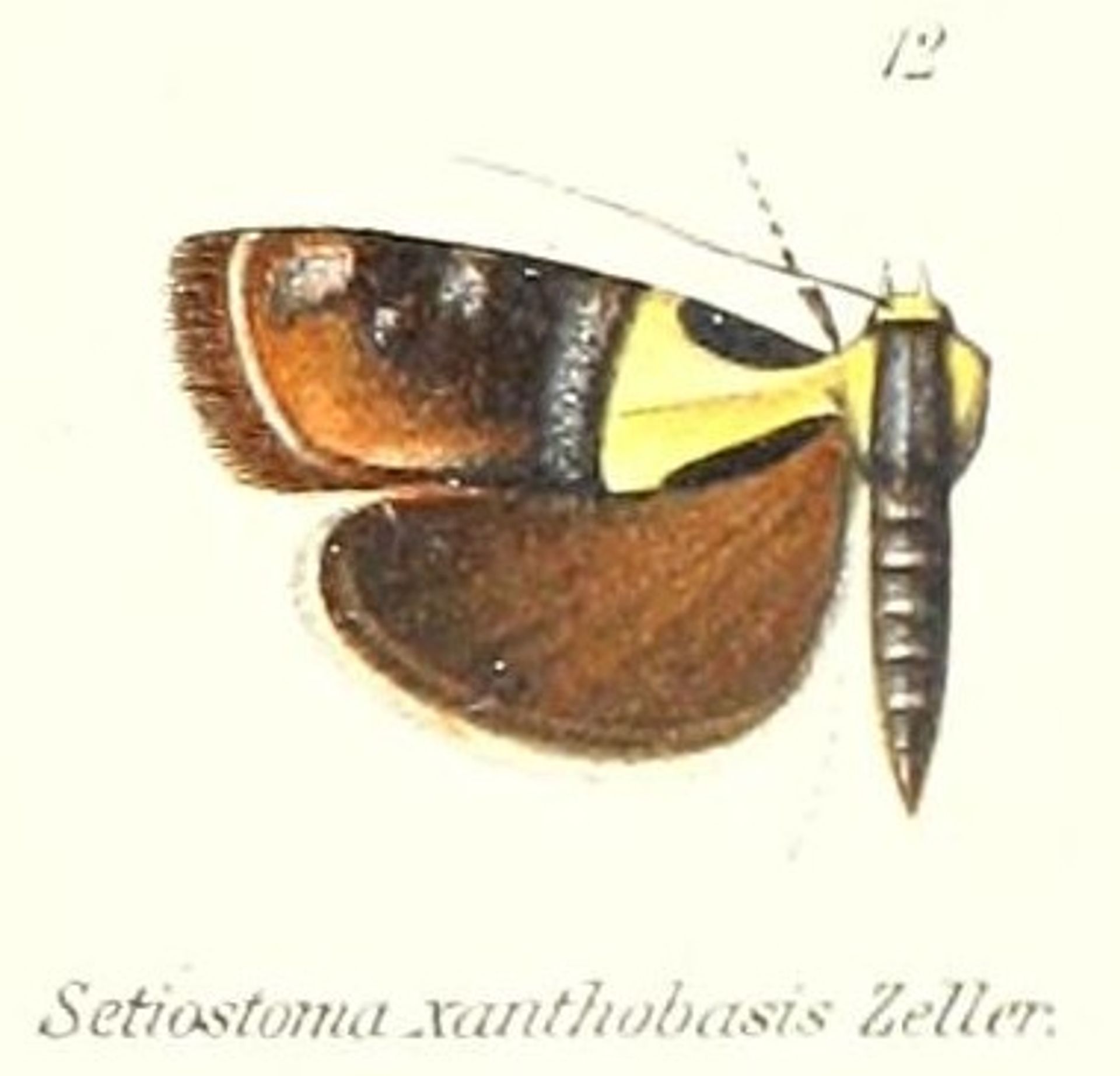
Small with wingspan 12–14 mm. Forewings dark brown with lemon yellow triangular area occupying basal third, continuous with yellow tegula. Basal third contains short costal lenticular spot and longer, narrower spot along wing margin, both concolorous with dark ground color. two-thirds of forewing with inconspicuous white patch near midlength of and smaller similar patch slightly more distad. Broad transverse band parallel to margin of yellow area, small scale group behind basal white area, short curved band extending from distal white area, and submarginal straight iridescent blue-violet band parallel to outer wing margin. Hindwings dark brown with white patch on basal half of margin.
Habitat
Associated with oak-dominated forests and woodlands. Larval consists of living oak leaves used for shelter construction.
Distribution
Atlantic Coastal Plain from southeastern Massachusetts south to central Florida and eastern Texas; extends north in Mississippi Valley to Missouri and Illinois.
Diet
Larvae feed on Quercus , specifically documented on Quercus nigra (water oak) and Quercus stellata (post oak). diet not documented.
Host Associations
- Quercus nigra - larval food plantwater oak
- Quercus stellata - larval food plantpost oak
Life Cycle
Larval stage constructs shelter of two leaves sandwiched together with silk, from which feeding occurs. Complete with , larva, pupa, and stages; specific timing of stages not documented.
Behavior
Larvae feed from within constructed leaf shelters, remaining concealed between two silk-bound leaves. are presumably , consistent with characteristics.
Ecological Role
Herbivore specializing on oak foliage; contributes to leaf litter production and nutrient cycling in oak forest . Serves as prey for .
Human Relevance
No documented economic or medical significance. Subject of entomological study and citizen science observation.
Similar Taxa
- Other Rectiostoma speciesShare -level characteristics of wing shape and general pattern elements, but differ in specific configuration of yellow basal area, dark spots, and presence/absence of blue-violet iridescent band
- Stenoma and related DepressariidaeSimilar size and general brown coloration, but lack the distinctive lemon yellow basal patch continuous with tegula and the specific white and iridescent banding pattern
More Details
Original description
Described by Philipp Christoph Zeller in 1876 under the basionym Setiostoma xanthobasis, later transferred to Rectiostoma.
Observation frequency
Documented in 244 iNaturalist observations as of data compilation, indicating moderate detection frequency within its range.