
Antaeotricha leucillana
Zeller, 1854
Pale Gray Bird-dropping Moth
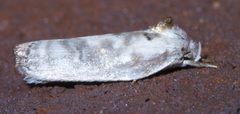
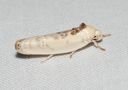
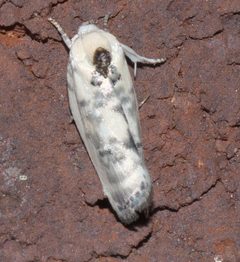
Antaeotricha leucillana, commonly known as the pale gray bird-dropping , is a small moth in the Depressariidae. First described by Philipp Christoph Zeller in 1854, it is widely distributed across eastern and central North America. The species exhibits a bird-dropping mimicry coloration as and has documented larval associations with several woody plant .
Pronunciation
How to pronounce Antaeotricha leucillana: //ænˌtiːoʊˈtraɪkə ljuːˌsɪˈlæ.nə//
These audio files are automatically generated. While they are not always 100% accurate, they are a good starting point.
Identification
The pale gray, relatively unpatterned wings and bird-dropping-like appearance distinguish this from many other small . The uniform coloration without spots or strong markings separates it from congeneric species such as Antaeotricha albulella, which typically shows dark spots on the forewings. Final identification may require examination of genitalia or comparison with closely related species in the .
Images
Appearance
have a wingspan of 15–23 mm. The forewings and body are pale gray, resembling bird droppings—a form of protective mimicry. The overall coloration is relatively uniform without strong patterning or contrasting markings.
Habitat
Associated with wooded and shrubby environments where plants occur. Larval includes foliage of various woody shrubs and trees.
Distribution
Eastern and central North America. Documented from: New Hampshire, Massachusetts, New York, Pennsylvania, District of Columbia, Virginia, North Carolina, Georgia, Alabama, Arkansas, Missouri, Kansas, Illinois, Iowa, Texas, Oregon, Louisiana, Manitoba, and Nova Scotia. Additional records from Saskatchewan and Vermont.
Seasonality
have been recorded on wing from April to August in Ohio, with peak activity during the warmer months.
Diet
Larvae feed on leaves of Pyracantha crenulata (firethorn), Malus (apple), Vaccinium corymbosum (highbush blueberry), and Acer (maple). feeding habits are not documented.
Host Associations
- Pyracantha crenulata - larval food plantfirethorn
- Malus - larval food plantapple
- Vaccinium corymbosum - larval food planthighbush blueberry
- Acer - larval food plantmaple
Ecological Role
Larval herbivore on woody plants. The bird-dropping mimicry likely serves as anti- defense.
Similar Taxa
- Antaeotricha albulellaSimilar size and general appearance, but A. albulella has one or two black spots on the forewings and white or pale gray hindwings, whereas A. leucillana has uniformly pale gray wings without spots.
More Details
Nomenclature
Originally described as Cryptolechia leucillana by Zeller in 1854; later transferred to Antaeotricha.
Observation frequency
Well-represented in citizen science databases with nearly 3,000 observations on iNaturalist, indicating it is frequently encountered and photographed by naturalists.