
Ethmia semilugens
Zeller, 1872
Ethmia semilugens is a small in the Ethmiidae (formerly placed in Depressariidae). It occurs in arid regions of the southwestern United States and northern Mexico, with active primarily in late winter and early spring in Texas, extending into September in Chihuahua. The produces two annually. Larvae feed on specific plants in the Boraginaceae family.
Pronunciation
How to pronounce Ethmia semilugens: /ˈɛθ.mi.ə ˌsɛm.ɪˈluː.dʒɛnz/
These audio files are automatically generated. While they are not always 100% accurate, they are a good starting point.
Identification
Distinguished from other Ethmia by the combination of brownish black forewings with broad white margin and the variable brownish coloration on the hindwing apex. The Ethmia contains over 50 species in North America, most occurring in the southwestern United States, and species-level identification often requires examination of genitalia.
Images
Appearance
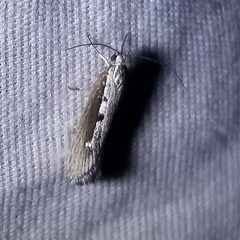
Forewings 8.7–12 mm in length. Forewings brownish black with broad white margin. Hindwings whitish, becoming brownish toward apex; sometimes mostly brownish except basally.
Habitat
Arid and semi-arid environments including desert scrub, grasslands, and open woodlands. Associated with supporting larval plants in the Boraginaceae .
Distribution
United States (Colorado, Texas, New Mexico, Arizona, southern California) and Mexico (northern Chihuahua).
Seasonality
active late February to March in southwestern Texas; activity extends to September in Chihuahua. Two per year.
Diet
Larvae feed on Phacelia calthifolia and Phacelia crenulata ( Boraginaceae) in California.
Host Associations
- Phacelia calthifolia - larval plantCalifornia
- Phacelia crenulata - larval plantCalifornia
Life Cycle
Two per year. Larvae feed on leaves of plants without constructing shelters.
Behavior
Larvae feed exposed on leaves without building shelters. attracted to light.
Ecological Role
Herbivore; larval stage consumes foliage of Boraginaceae plants. Specific ecological relationships beyond herbivory are not documented.
Similar Taxa
- Other Ethmia speciesApproximately 50+ occur in North America, most in the Southwest; many share similar black-and-white coloration and require genitalia examination for definitive identification
More Details
Taxonomic placement
The Ethmia has been moved between in recent taxonomic revisions. It was formerly placed in Depressariidae, then Coleophoridae, and is now generally treated as the family Ethmiidae within the superfamily Gelechioidea.
Sources and further reading
- BugGuide
- Wikipedia
- GBIF taxonomy match
- iNaturalist taxon
- NCBI Taxonomy
- Catalogue of Life
- What's in a Name? Leslie Saul-Gershenz and Norm Gershenz | Bug Squad
- Bug Eric: My Personal National Moth Week, 2017
- Bug Eric: September 2017
- Bug Eric: New Mexico Night Bugs
- Nota Lepidopterologica goes advanced open access with Pensoft Publishers | Blog
- Uncategorized | Blog - Part 22