
Agonopterix atrodorsella
(Clemens, 1863)
Beggartick Leaffolder Moth
A small in the Depressariidae, first described from North America in 1863. are active year-round depending on location, with a single annually. The overwinters as an adult and is associated with several herbaceous plant .
Pronunciation
How to pronounce Agonopterix atrodorsella: //ˌæɡəˈnɒptərɪks ˌætroʊdɔːrˈsɛlə//
These audio files are automatically generated. While they are not always 100% accurate, they are a good starting point.
Identification
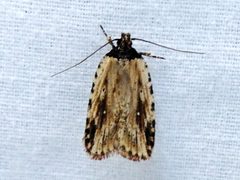
Distinguished from similar Agonopterix by the combination of yellow ochreous forewings with multiple black costal dots and the distinctive patch beyond the black discal dot. The yellowish hindwings and small size further aid identification.
Images
Appearance
Small with wingspan 18–23 mm. Forewings yellow ochreous with several black costal dots running from base to wing tip; black dot on basal portion of disc with patch beyond. Hindwings yellowish.
Habitat
Associated with plants in open, disturbed where Eupatorium, Coreopsis, Bidens, and Myrica grow; likely meadows, field edges, and wetland margins.
Distribution
Eastern North America: recorded from Ontario, Quebec, New Brunswick (Canada) and Illinois, Indiana, Kentucky, Maine, Maryland, Massachusetts, Michigan, New Hampshire, New York, North Carolina, Ohio, Vermont, Wisconsin (USA).
Seasonality
recorded in all months depending on locality; single per year with adults.
Diet
Larvae feed on Eupatorium , Coreopsis species, Bidens frondosa, and Myrica asplenifolia. diet not documented.
Host Associations
- Eupatorium - larval foodplantmultiple
- Coreopsis - larval foodplantmultiple
- Bidens frondosa - larval foodplant
- Myrica asplenifolia - larval foodplant
Life Cycle
One per year. Overwinters as . Larval stage feeds on plants; and stages not described in sources.
Behavior
Overwinters as , allowing year-round activity in suitable conditions. Larvae are leaf folders or miners on plants (implied by ).
Ecological Role
Herbivore; larval feeding on Asteraceae and Myricaceae plants. Potential prey for .
Similar Taxa
- Agonopterix speciesMany congeneric share similar size and wing pattern; A. atrodorsella distinguished by specific arrangement of black costal dots and patch on forewing. No specific similar species documented in sources.