
Carcina
Hübner, 1825
oak long-horned flat-body moths
Species Guides
1- Carcina quercana(oak lantern)
Carcina is a small of micromoths in the Peleopodidae, containing four distributed across Europe and the eastern Mediterranean. The genus is notable for its members' distinctive appearance: pastel pink or purple wings with yellow markings and exceptionally long relative to body size. The most widespread species, C. quercana, serves as for the specialized Venanides carcinae. A recently described species, C. ingridmariae, was discovered in 2025 after being misidentified as C. quercana for over a century, representing a rare case of overlooked colorful European diversity.
Pronunciation
How to pronounce Carcina: //kɑːrˈsɪnə//
These audio files are automatically generated. While they are not always 100% accurate, they are a good starting point.
Identification
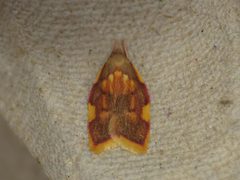
Distinguished from other European Peleopodidae by the combination of small size (~20 mm wingspan), pink-purple wing coloration with yellow markings, and disproportionately long . Within the , C. quercana and C. ingridmariae are externally similar and were historically confused; separation requires examination of genitalia or (genetic divergence >6%). C. quercana is widespread across Europe; C. ingridmariae is restricted to the eastern Mediterranean (Croatia, Greece, Cyprus, Turkey). C. haemographa and C. luridella have more limited distributions and differ in color pattern details.
Images
Appearance
Small with wingspan approximately 20 mm. Wings display pink to purple base coloration with yellow spots or markings. are strikingly long, often exceeding body length—hence the 'long-horned flat-body'. Body is relatively flattened. The recently described C. ingridmariae shares these general features with C. quercana, requiring close examination of genitalia for definitive separation.
Habitat
Woodland , particularly those containing trees. Associated with Fagaceae (Quercus, Fagus) and Rosaceae. Larvae occur on saplings, seedlings, and epicormic growth following storm displacement from higher positions.
Distribution
Europe and eastern Mediterranean region. C. quercana: widespread from North Africa across Europe to the Balkans, recently introduced to North America. C. ingridmariae: Croatia, Greece, Cyprus, Turkey. C. haemographa and C. luridella: more restricted ranges. Records from Denmark, Norway, Sweden (GBIF).
Seasonality
of C. quercana fly from May to October, peaking in July. Single per year; no evidence of second generation despite occasional late-season larval observations attributed to drought stress.
Diet
Larvae moderately on deciduous trees, favoring Fagaceae (Quercus spp., Fagus spp.) and Rosaceae. Recorded on fruit trees including apple, pear, cherry, and plum. Larvae skeletonize leaves under silken webs.
Host Associations
- Venanides carcinae - Regular solitary of C. quercana; specialized and co-distributed with
- Quercus - food plantFagaceae for larval feeding
- Fagus - food plantFagaceae for larval feeding
- Rosaceae (apple, pear, cherry, plum) - food plantFruit tree ; minor pest status
Life Cycle
Single . Larvae feed on leaves under silken webs, skeletonizing foliage. Storms displace larvae from high positions to lower saplings and seedlings where they re-establish. occurs in protected locations. Some proportion of reaches pupation before of first generation, allowing host population persistence.
Behavior
Larvae produce silken webs while feeding. Storm-mediated displacement from to lower growth is a regular dynamic. are .
Ecological Role
Herbivore on deciduous trees; minor pest of Rosaceae fruit trees. for specialized Venanides carcinae, forming a tight parasitoid-host interaction. High levels of and hyperparasitism, plus vespid or bird on parasitoid cocoons, regulate .
Human Relevance
C. quercana is a minor pest of cultivated Rosaceae fruit trees. The appears on the cover of a British identification guide due to its distinctive appearance. C. ingridmariae was named in 2025 to commemorate the describer's 42nd wedding anniversary. of C. quercana sequenced (409 Mb, 30 , 18,108 protein-coding genes), providing phylogenomic resources for Peleopodidae.
Similar Taxa
- Other Peleopodidae genera in EuropeCarcina distinguished by pink-purple coloration with yellow spots and exceptionally long ; other lack this combination
- Carcina quercana vs. C. ingridmariaeHistorically confused due to similar size, coloration, and pattern; require genitalia examination or for separation
Misconceptions
C. ingridmariae was misidentified as C. quercana for over 100 years despite being described as 'unmistakable' in coloration. First published record from Crete in 1916 was incorrect. External similarity masked significant genetic divergence (>6% barcode difference) and distinct genital .
More Details
Taxonomic history
described by Hübner in 1825. placement has varied: treated as Depressariidae in some sources, Peleopodidae in current classifications. Only two occur in Europe (C. quercana, C. ingridmariae); two additional species (C. haemographa, C. luridella) have more restricted distributions.
Conservation and research significance
C. quercana represents the only UK representative of Peleopodidae, filling a phylogenomic gap. Discovery of C. ingridmariae demonstrates that even colorful, apparently well-known European Lepidoptera can harbor overlooked cryptic diversity when external similarity masks reproductive isolation.
Sources and further reading
- BugGuide
- Wikipedia
- GBIF taxonomy match
- iNaturalist taxon
- NCBI Taxonomy
- Catalogue of Life
- Til moth do us part: new species marks 42 years of marriage
- Notes on the biology of Carcina quercana (Fabricius) (Lepidoptera: Peleopodidae) and its parasitoids (Hymenoptera) in Germany and the Netherlands
- Discovery of the genus Venanides Mason 1981 (Hymenoptera: Braconidae, Microgastrinae) in Europe, with description of a new species parasitizing Carcina quercana (Fabricius) (Lepidoptera: Peleopodidae)
- The genome sequence of the long-horned flat-body, Carcina quercana (Fabricius, 1775).