
Autostichinae
Le Marchand, 1947
Genus Guides
1Autostichinae is a of small within the Autostichidae, superfamily Gelechioidea. The group was historically classified within Oecophoridae but is now recognized as a distinct family-level lineage, though its exact familial boundaries remain subject to revision. The subfamily contains numerous of generally inconspicuous, moths. Their phylogenetic relationships within Gelechioidea are not fully resolved.
Pronunciation
How to pronounce Autostichinae: /ˌɔːtəˈstɪkɪniː/
These audio files are automatically generated. While they are not always 100% accurate, they are a good starting point.
Identification
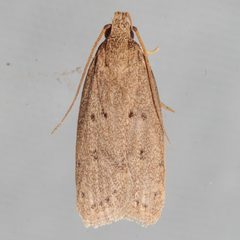
Members of Autostichinae are small to medium-sized with relatively plain, often brownish or grayish forewings lacking bold patterns. They can be distinguished from related Oecophorinae by more subdued coloration and generally less pronounced wing markings. The lacks the distinctive features of twirler moths (Gelechiidae) such as pronounced upturned wing tips. Definitive identification to subfamily level typically requires examination of genitalia or molecular data.
Images
Habitat
Autostichinae occupy diverse terrestrial including forests, woodlands, scrublands, and grasslands. Many species are associated with dead plant material, leaf litter, or decaying wood. Some occur in arid and semi-arid regions.
Distribution
The has a broad distribution with greatest diversity in the Palearctic region, particularly the Mediterranean basin and central Asia. also occur across the Nearctic, Afrotropical, and Oriental regions.
Seasonality
activity patterns vary by and region; many are active from spring through autumn in temperate zones. Some species exhibit multivoltine patterns with overlapping .
Behavior
are and attracted to light. Larval stages are generally concealed, often feeding within dead plant material, leaf litter, or decaying vegetation rather than living plant tissues.
Ecological Role
Larvae function as , contributing to decomposition of dead plant material. The represents a component of insect diversity in many terrestrial .
Human Relevance
No significant economic importance. occasionally enter buildings when attracted to artificial light. Not known to be agricultural pests.
Similar Taxa
- OecophorinaeHistorically confused with Autostichinae; distinguished by generally more colorful and patterned wings, and different larval habits often involving living plant material
- GelechiidaeSimilar small size but typically have more pointed wing tips and often exhibit more specialized associations with living plants
- SymmocidaeClosely related sometimes merged with Autostichidae; distinctions rely on subtle morphological characters and genitalia structure
More Details
Taxonomic History
The classification of Autostichinae has undergone substantial revision. Le Marchand established the in 1947. The group was long treated as part of Oecophoridae, but molecular and morphological studies support recognition as a separate Autostichidae, sometimes expanded to include Symmocidae and Holcopogonidae.
Phylogenetic Uncertainty
Relationships within Gelechioidea remain incompletely resolved. The boundaries between Autostichidae, Symmocidae, and certain gelechioid such as Deoclona and Syringopais continue to be debated, with some treatments merging these into a broadly defined Autostichidae.