
Autostichidae
Le Marchand, 1947
Subfamily Guides
6Autostichidae is a of small in the superfamily Gelechioidea, comprising approximately 600 described worldwide. The family is divided into six : Autostichinae, Deocloninae, Glyphidocerinae, Holcopogoninae, Oegoconiinae, and Symmocinae. Species-level has been extensively studied in Asia, particularly for the Meleonoma in China, where over 70 new species have been described in recent years. The family exhibits considerable morphological diversity in genitalia structure, which serves as a primary diagnostic feature for species identification.
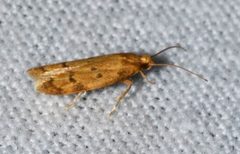
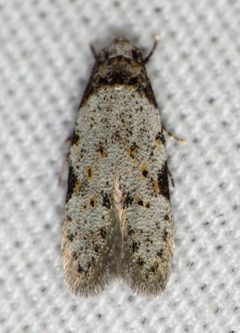
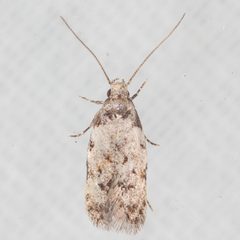
Pronunciation
How to pronounce Autostichidae: /ˌɔː.toʊˈstɪkɪdiː/
These audio files are automatically generated. While they are not always 100% accurate, they are a good starting point.
Identification
Autostichidae are small (typically 5–15 mm wingspan) that generally lack distinctive external features for -level recognition. Identification relies heavily on genitalia , particularly the structure of male valvae and , and female signum. The family can be distinguished from related Oecophoridae by characters of the wing venation and genitalia; the Punctulata was transferred to Autostichidae based on both morphological and molecular data. within genera are often separated by subtle differences in genital armature, including processes on the valvae, shape of the aedeagus, and patterns.
Images
Habitat
associations are poorly documented for most . One species, Ptochoryctis sundarbanica, has been documented from degraded mangrove habitat in the Sundarbans of India. The Meleonoma has been collected across diverse localities in China including forested mountain regions, with distribution maps showing species groups occupying distinct geographic ranges.
Distribution
Worldwide distribution with records from North America (Vermont, USA), Europe (Denmark, Norway, Sweden), and Asia (China, India, Taiwan). The Meleonoma is particularly diverse in China, with described from multiple provinces including Hainan Island, Chongqing, and Zhejiang (Tianmushan). Distribution patterns within Meleonoma show two primary species-groups with distinct geographic ranges across China.
Similar Taxa
- OecophoridaeHistorically confused with Autostichidae; the Punctulata was transferred from Oecophoridae to Autostichidae based on morphological characters and molecular data. Differences in wing venation and genitalia structure separate the .
- GelechiidaeBoth are in the superfamily Gelechioidea and share small size and general habitus; Autostichidae generally lack the distinctive forewing patterning common in many gelechiids and differ in genitalia structure.
More Details
Taxonomic activity
The has been the subject of intensive taxonomic revision in China, with four major studies of the Meleonoma published between 2020 and 2024 describing over 70 new . These studies have used genitalia to define species-groups and provide identification keys.
Subfamily classification
The six recognized (Autostichinae, Deocloninae, Glyphidocerinae, Holcopogoninae, Oegoconiinae, Symmocinae) were established between 1947 and 1998, with Hodges (1998) contributing significantly to the modern classification.
Sources and further reading
- BugGuide
- Wikipedia
- GBIF taxonomy match
- iNaturalist taxon
- NCBI Taxonomy
- Catalogue of Life
- A new species of the genus Ptochoryctis Meyrick, 1894 (Lepidoptera: Autostichidae) from India
- Study of the genus Meleonoma Meyrick, 1914 (Lepidoptera: Autostichidae) from China, with descriptions of fifteen new species
- Study of the genus Meleonoma Meyrick, 1914 (Lepidoptera: Autostichidae) from China, with descriptions of twenty-one new species (II)
- Taxonomic study of the genus Punctulata Wang (Lepidoptera: Autostichidae) from China, with descriptions of two new species
- Genus Meleonoma Meyrick, 1914 (Lepidoptera, Autostichidae) from Hainan Island, China, with descriptions of sixteen new species
- Study of the genus Meleonoma Meyrick, 1914 (Lepidoptera: Autostichidae) from China (III), with descriptions of eighteen new species
- Thirteen new species of the genus Meleonoma Meyrick, 1914 (Lepidoptera, Autostichidae) from China.