
Dyseriocrania auricyanea
(Walsingham, 1882)
Dyseriocrania auricyanea is a small in the Eriocraniidae, described by Walsingham in 1882. It is to California and active in early spring. The is notable for its distinctive golden-brown forewings marked with purplish patches. Larvae are leaf miners on several native oak species (Quercus).
Pronunciation
How to pronounce Dyseriocrania auricyanea: //daɪˌsɛri.oʊˈkreɪniə ˌɔːrɪˈsaɪəniə//
These audio files are automatically generated. While they are not always 100% accurate, they are a good starting point.
Identification
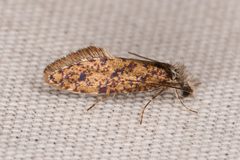
Distinguished from other Dyseriocrania by the combination of pale golden-brown forewings with distinct purplish patches and specific wing measurements. The seasonal timing (March–April) and California distribution further aid identification. Larval mines on oak leaves—starting as linear passages then expanding to full-length inflated blotches—are characteristic.
Images
Appearance
Small with forewings pale golden brown, marked with several small patches of darker purplish . Hindwings slightly darker, grayish brown with slight purplish luster. Wingspan 10.5–13 mm in males, 9.3–10.5 mm in females. Larvae have brownish body and dark brown .
Habitat
Associated with oak woodlands and coastal sage scrub containing Quercus . Larval is within leaves of coast live oak, blue oak, coastal sage scrub oak, valley oak, and interior live oak.
Distribution
to California, United States.
Seasonality
active early March to mid-April. One per year.
Diet
Larvae feed on leaves of Quercus agrifolia (coast live oak), Quercus douglasii (blue oak), Quercus dumosa (coastal sage scrub oak), Quercus lobata (valley oak), and Quercus wislizenii (interior live oak). feeding habits unknown.
Host Associations
- Quercus agrifolia - larval coast live oak
- Quercus douglasii - larval blue oak
- Quercus dumosa - larval coastal sage scrub oak
- Quercus lobata - larval valley oak
- Quercus wislizenii - larval interior live oak
Life Cycle
One per year. laid on oak leaves. Larvae mine leaves, creating linear-to-curved initial passages that expand to full-length inflated blotches. Full-grown larvae exit mines through slit in upper leaf , drop to ground, burrow into leaf litter, and form whitish silken cocoon covered with darker soil particles. in cocoon; emerge March–April.
Behavior
Larvae are leaf miners. Full-grown larvae demonstrate negative geotaxis by dropping from leaves to ground to pupate in soil litter.
Ecological Role
on native California oaks. Contributes to nutrient cycling through leaf litter processing during larval .
Similar Taxa
- Other Dyseriocrania speciesSimilar size and characteristics; distinguished by wing coloration patterns, specific associations, and California
- Other EriocraniidaeShare primitive features; D. auricyanea distinguished by golden-brown forewings with purplish markings and specific geographic range
More Details
Original description
First described as Micropteryx auricyanea by Walsingham in 1882; later transferred to Dyseriocrania.
Larval mine characteristics
Mine architecture is diagnostic: initial linear or slightly curved passage to leaf margin, then rapid expansion to inflated full-length blotch.