
Dyseriocrania
Spuler, 1910
Species Guides
2- Dyseriocrania auricyanea
- Dyseriocrania griseocapitella(Chinquapin leaf-miner)
Dyseriocrania is a of small primitive in the Eriocraniidae, first described by Spuler in 1910. The genus contains four recognized distributed across the Holarctic region. Members are characterized by their diminutive size, with wingspans ranging from 9 to 13 mm, and relatively broad wing compared to body proportions. These moths represent one of the more derived genera within the Eriocraniidae, a family considered among the most basal lineages of Lepidoptera.
Pronunciation
How to pronounce Dyseriocrania: /daɪˌsɪri.oʊˈkreɪniə/
These audio files are automatically generated. While they are not always 100% accurate, they are a good starting point.
Identification
Distinguished from the related Eriocrania by subtle genitalic differences and wing venation patterns; accurate identification to level typically requires dissection and examination of genitalia. The broad wing shape relative to small body size separates Dyseriocrania from most other microlepidopteran . Within Eriocraniidae, Dyseriocrania species generally show more pronounced metallic coloration than Eriocrania species.
Images
Appearance
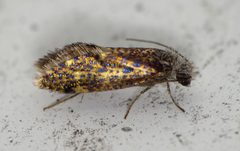
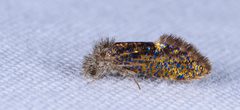
Small with wingspan 9–13 mm. Wings relatively broad in proportion to body size. Coloration and detailed patterning vary by ; D. subpurpurella has purplish forewings, D. auricyanea shows golden-cyan iridescence.
Distribution
Holarctic distribution. Documented from Denmark (DK), Norway (NO), and Sweden (SE) in Europe; distribution extends to northern Asia and North America.
Similar Taxa
- EriocraniaMost similar within Eriocraniidae; distinguished by wing venation and genitalia structure, with Dyseriocrania generally showing broader wings and more metallic coloration