
Eriocrania
Zeller, 1851
Birch leaf-mining moths
Species Guides
1- Eriocrania semipurpurella(Purplish birch-miner)
Eriocrania is a Palearctic of small, leaf-mining in the Eriocraniidae. are active in early spring (March–May), flying in sunshine around trees. Larvae are specialized miners of birch leaves (Betula spp.), forming large blotch mines with distinctive patterns. The genus exhibits pronounced fluctuations between years and has been extensively studied for its ecological interactions, including competition with other leaf-miners and responses to environmental stressors such as urbanization and pollution.
Pronunciation
How to pronounce Eriocrania: /ˌɛri.oʊˈkreɪniə/
These audio files are automatically generated. While they are not always 100% accurate, they are a good starting point.
Identification
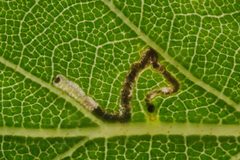
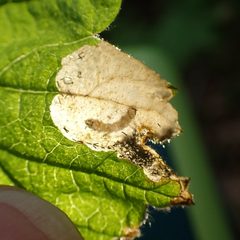
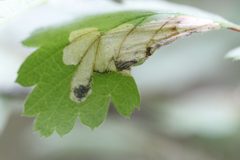
are and active in early spring sunshine, often flying around birch trees. At rest, wings are held steeply and show metallic purple or golden coloration. Many cannot be reliably distinguished by external alone; genitalia dissection is required for definitive identification. Larvae create distinctive large blotch mines in birch leaves with long, intertwining strands of . Vacated mines of Eriocrania semipurpurella and E. sangii cannot be reliably distinguished.
Images
Appearance
Small with metallic purple or golden coloration. Wings held at a steep angle when at rest, sometimes with net-like or mottled markings. covered with spiky , giving a woolly appearance (reflected in the name, from Greek erion 'wool' and kranion 'head'). of many are difficult to distinguish visually and require genitalia dissection for reliable identification.
Habitat
containing birch trees (Betula pendula, B. pubescens, and related ), including natural forests, urban parks, public gardens, roadsides, courtyards, and wastelands. Requires undisturbed natural soil beneath trees for prepupal and pupal survival. Occurs in both pristine and polluted environments, including industrial barrens.
Distribution
Palearctic distribution. Documented from northwestern Russia (St. Petersburg region), Finland, Sweden, Norway, Denmark, UK (Oxford area), and northwest China (Qinghai Province). GBIF records indicate presence in Denmark, Norway, and Sweden. show in urban landscapes and ability to recolonize previously vacant .
Seasonality
emerge and fly in early spring, primarily March through May in temperate regions. Activity peaks during sunny conditions, with dawn noted. Timing closely synchronized with birch leaf budburst. Larval mines appear shortly after leaves are fully open in spring.
Diet
Larvae feed internally within young birch leaves (Betula spp.), forming large blotch mines. Documented include Betula pendula (silver birch), B. pubescens (downy birch), and B. pubescens subsp. czerepanovii (mountain birch). do not feed.
Host Associations
- Betula pendula - larval silver birch
- Betula pubescens - larval downy birch
- Betula pubescens subsp. czerepanovii - larval mountain birch
Life Cycle
laid in leaf buds or leaf parenchyma. Larvae mine within leaves, forming large blotches with long, intertwining strands. Larval stage lasts approximately 3–4 weeks. exit mines and drop to soil, where they construct tough silken cocoons. Prepupal and pupal stages spend nearly 11 months in soil beneath trees. Some exhibit semivoltine with fluctuations. High larval mortality (>80% in some populations) due to unidentified factors.
Behavior
activity in sunshine, often around trees. may be found motionless on branches on cold, sunny days and can be collected by beating branches over a tray. densities fluctuate 10- to 100-fold between consecutive years. Larvae in experience double the mortality of solitary miners.
Ecological Role
Specialized herbivore on birch, contributing to leaf damage and premature leaf abscission. Supports diverse of parasitic (including Pnigalio eriocraniae, Grypocentrus spp.) and serves as food source for birds and ants. Subject to apparent competition with other leaf-miners (Coleophora, Epirrita autumnata) and interference competition with free-living folivores. In polluted environments, experiences reduced control, creating enemy-free space that allows higher densities.
Human Relevance
Used as model organism for studying insect , competition, and responses to environmental stressors including urbanization and industrial pollution. Long-term study systems exist in St. Petersburg, Russia (40 years) and Oxford, UK (25 years). No significant economic or agricultural impact.
Similar Taxa
- ColeophoraBoth are leaf-mining Lepidoptera on birch; Eriocrania forms blotch mines while Coleophora typically forms case-bearing larval shelters and linear mines; of Eriocrania are and metallic, while Coleophora adults are generally and dull-colored
- Epirrita autumnataBoth feed on birch foliage; Eriocrania are leaf-miners with larvae inside leaves, while Epirrita are external leaf-chewers (geometrid caterpillars); negative correlations in abundance suggest competitive or interference interactions
More Details
Etymology
From Greek erion (wool) + kranion (upper part of the ), referring to the spiky on the head.
Population dynamics
show no directional trend despite four decades of urbanization in St. Petersburg, demonstrating of specialized herbivores. In polluted industrial barrens, densities reach 2.7× higher than pristine forests due to disruption of control.
Research importance
One of the most extensively studied leaf-mining systems, with continuous monitoring data spanning 25–40 years at multiple sites, providing exceptional insights into spatial , metapopulation dynamics, and climate effects on insect herbivores.
Sources and further reading
- BugGuide
- Wikipedia
- GBIF taxonomy match
- iNaturalist taxon
- NCBI Taxonomy
- Catalogue of Life
- Ant predation of Eriocrania miners in a polluted area
- Spatial and Temporal Dynamics of Birch-Mining Eriocrania Moths in an Urban Landscape over Four Decades
- Effects of scale on detecting interactions between Coleophora and Eriocrania leaf‐miners
- Contrasting response of mountain birch to damage by Eriocrania leafminers in polluted and unpolluted habitats
- Effects of Air Pollution on Host Plant Quality, Individual Performance, and Population Density of Eriocrania Miners (Lepidoptera: Eriocraniidae)
- Direct and indirect competitive effects of foliage feeding guilds on the performance of the birch leaf‐miner Eriocrania
- Top‐down effects on population dynamics of Eriocrania miners (Lepidoptera) under pollution impact: does an enemy‐free space exist?
- Changes in distribution of birches and birch‐feedingEriocraniamoths in St Petersburg, Russia, between 1986 and 2001
- A new species of Pnigalio (Hymenoptera, Eulophidae) parasitizing Eriocrania semipurpurella alpina (Lepidoptera, Eriocraniidae) in China, with its biology and a key to Chinese known species
- Long‐term dynamics of leaf miners, Eriocrania spp., on mountain birch: alternate year fluctuations and interaction with Epirrita autumnata
- Behavioural responses of the leaf‐chewing guild to the presence of Eriocrania mines on silver birch ( Betula pendula )
- Egg Structure and Life-history of two Species Groups of Grypocentrus (Hymenoptera: Ichneumonidae), Monophagous Parasitoids of Spring Leaf-mining Eriocrania-moths on Birch (Lepidoptera: Eriocra niidae)
- Figure 11 from: Li T, Yang Z-Q, Sun S-P, Wang R (2017) A new species of Pnigalio (Hymenoptera, Eulophidae) parasitizing Eriocrania semipurpurella alpina (Lepidoptera, Eriocraniidae) in China, with its biology and a key to Chinese known species. ZooKeys 687: 149-159. https://doi.org/10.3897/zookeys.687.14903
- Figure 1 from: Li T, Yang Z-Q, Sun S-P, Wang R (2017) A new species of Pnigalio (Hymenoptera, Eulophidae) parasitizing Eriocrania semipurpurella alpina (Lepidoptera, Eriocraniidae) in China, with its biology and a key to Chinese known species. ZooKeys 687: 149-159. https://doi.org/10.3897/zookeys.687.14903
- Figure 2 from: Li T, Yang Z-Q, Sun S-P, Wang R (2017) A new species of Pnigalio (Hymenoptera, Eulophidae) parasitizing Eriocrania semipurpurella alpina (Lepidoptera, Eriocraniidae) in China, with its biology and a key to Chinese known species. ZooKeys 687: 149-159. https://doi.org/10.3897/zookeys.687.14903
- The complete mitogenome of Eriocrania semipurpurella alpina Xu, 1990 (Lepidoptera: Eriocraniidae).