
Eriocraniidae
Rebel, 1901
Sparkling Archaic Sun Moths
Genus Guides
4- Dyseriocrania
- Eriocrania(Birch leaf-mining moths)
- Eriocraniella
- Neocrania
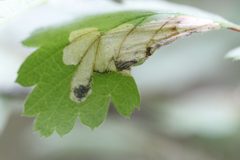
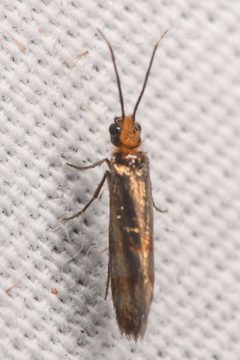
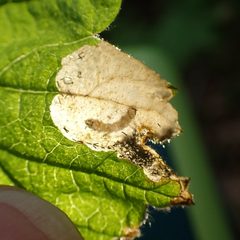
Eriocraniidae is a of primitive restricted to the Holarctic region, comprising six extant . are small (forewing length 4–7 mm), , and typically active in early spring, often flying in sunshine around trees. Larvae are leaf miners on woody angiosperms, primarily in the order Fagales, with most feeding on birch (Betula) and oak (Quercus). The family retains many ancestral morphological features and represents one of the earliest diverging lineages within Lepidoptera.
Pronunciation
How to pronounce Eriocraniidae: /ˌɛrioʊˌkreɪnˈiːaɪdiː/
These audio files are automatically generated. While they are not always 100% accurate, they are a good starting point.
Identification
Distinguished from other small by combination of metallic golden or purple forewing coloration, spring period, and association with birch or oak trees. Purple forms are particularly challenging to separate from each other and often require dissection and examination of genitalia. The can be separated from Micropterigidae, another primitive moth family, by wing venation and other morphological characters.
Images
Appearance
Small with forewing length of 4–7 mm. Forewings display metallic coloration in pale golden or purple shades, often with mottled patterns. Purple-colored can be difficult to distinguish visually and may require genitalia examination for accurate identification. possess a functional used for drinking water or sap. Females have a piercing ovipositor for inserting into leaf tissue.
Habitat
Deciduous and mixed forests, woodlands, and wooded areas containing trees. are found around host trees during periods. Larvae occur within leaves of woody angiosperms.
Distribution
Holarctic region, including North America, Europe, and Asia. Records from Scandinavia (Denmark, Norway, Sweden), southern Europe (Italy), Japan, and China (Qinghai Province).
Seasonality
emerge early in northern temperate spring, flying at dawn and in sunshine. period is relatively brief and tied to tree .
Diet
drink water or sap using their . Larvae are phytophagous, feeding as leaf miners in early instars and becoming sap-feeders in later instars.
Host Associations
- Betula - primary larval birch
- Quercus - primary larval oak
- Alnus - larval alder
- Fagus - larval beech
- Prunus - larval
- Crataegus - larval hawthorn
- Malus - larval apple
- Acer - larval maple
- Salix - larval willow
Life Cycle
are laid by females using a piercing ovipositor, inserted into leaf parenchyma or leaf buds. Larvae hatch and initially create linear or serpentine leaf mines, then transition to sap-feeding in later instars and produce large blotch mines containing , intertwining . Larvae exit mines to pupate in soil within tough, silken cocoons. Pupae are decticous (with functional ). emerge the following spring.
Behavior
activity, often in swarms around trees. sometimes come to light. When disturbed from branches by tapping, individuals fall and remain motionless ().
Ecological Role
Larvae function as leaf miners and sap-feeders on deciduous trees, representing minor herbivores in forest . Serve as for , including in the Eulophidae.
Human Relevance
Minor significance. are occasionally collected by entomologists and enthusiasts due to their metallic coloration and early spring activity. Larval mining damage to trees is generally negligible. Some have been studied as indicators of air pollution effects on forest .
Similar Taxa
- MicropterigidaeAnother primitive with ; distinguished by different wing venation and adults that feed on pollen rather than sap
- NepticulidaeSmall with leaf-mining larvae; distinguished by different , typically or habits, and different wing markings
Sources and further reading
- BugGuide
- Wikipedia
- GBIF taxonomy match
- iNaturalist taxon
- NCBI Taxonomy
- Catalogue of Life
- Exploring the Diversity of Micropterigidae and Eriocraniidae (Lepidoptera) in South Italian Forests by DNA Barcoding
- Biosystematic study of Issikiocrania japonicella Moriuti (Lepidoptera: Eriocraniidae), with description of immature stages
- Notes on the Larval Hosts and Habits of Some North American Eriocraniidae and Acanthopteroctetidae
- Effects of Air Pollution on Host Plant Quality, Individual Performance, and Population Density of Eriocrania Miners (Lepidoptera: Eriocraniidae)
- A new species of Pnigalio (Hymenoptera, Eulophidae) parasitizing Eriocrania semipurpurella alpina (Lepidoptera, Eriocraniidae) in China, with its biology and a key to Chinese known species
- Figure 1 from: Li T, Yang Z-Q, Sun S-P, Wang R (2017) A new species of Pnigalio (Hymenoptera, Eulophidae) parasitizing Eriocrania semipurpurella alpina (Lepidoptera, Eriocraniidae) in China, with its biology and a key to Chinese known species. ZooKeys 687: 149-159. https://doi.org/10.3897/zookeys.687.14903
- Figure 11 from: Li T, Yang Z-Q, Sun S-P, Wang R (2017) A new species of Pnigalio (Hymenoptera, Eulophidae) parasitizing Eriocrania semipurpurella alpina (Lepidoptera, Eriocraniidae) in China, with its biology and a key to Chinese known species. ZooKeys 687: 149-159. https://doi.org/10.3897/zookeys.687.14903
- Figure 2 from: Li T, Yang Z-Q, Sun S-P, Wang R (2017) A new species of Pnigalio (Hymenoptera, Eulophidae) parasitizing Eriocrania semipurpurella alpina (Lepidoptera, Eriocraniidae) in China, with its biology and a key to Chinese known species. ZooKeys 687: 149-159. https://doi.org/10.3897/zookeys.687.14903
- Figures 3-10 from: Li T, Yang Z-Q, Sun S-P, Wang R (2017) A new species of Pnigalio (Hymenoptera, Eulophidae) parasitizing Eriocrania semipurpurella alpina (Lepidoptera, Eriocraniidae) in China, with its biology and a key to Chinese known species. ZooKeys 687: 149-159. https://doi.org/10.3897/zookeys.687.14903
- Figures 12-17 from: Li T, Yang Z-Q, Sun S-P, Wang R (2017) A new species of Pnigalio (Hymenoptera, Eulophidae) parasitizing Eriocrania semipurpurella alpina (Lepidoptera, Eriocraniidae) in China, with its biology and a key to Chinese known species. ZooKeys 687: 149-159. https://doi.org/10.3897/zookeys.687.14903
- The complete mitogenome of Eriocrania semipurpurella alpina Xu, 1990 (Lepidoptera: Eriocraniidae).