
Vitacea polistiformis
(Harris, 1854)
grape root borer, Grape Root Borer Moth
Vitacea polistiformis, commonly known as the , is a clearwing moth in the Sesiidae. It is a significant agricultural pest of grapevines (Vitis spp.) in the eastern and midwestern United States, where larval feeding on roots causes 'slow vine decline' that may take 5–10 years to become visible aboveground. are Batesian mimics of Polistes paper wasps. As few as nine larvae can kill a mature vine with an 8-inch base circumference.
Pronunciation
How to pronounce Vitacea polistiformis: /vɪˈteɪʃə pəˌlɪstɪˈfɔrmɪs/
These audio files are automatically generated. While they are not always 100% accurate, they are a good starting point.
Identification
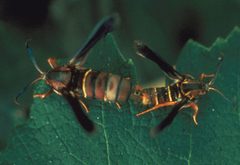
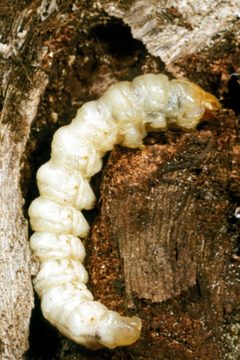
can be distinguished from actual Polistes by their : have filamentous or slightly clubbed antennae, while wasps have elbowed (geniculate) antennae. The transparent wings with dark veining and borders are characteristic of Sesiidae. Larvae found in grapevine roots are identifiable by their association with the plant and location (root tissue); they lack the C-shaped curvature of scarab and have a more cylindrical form with a well-sclerotized capsule.
Images
Appearance
are -mimicking with transparent wings due to reduced scaling, a characteristic of the Sesiidae. The body is dark with yellow or orange markings that resemble the coloration of Polistes paper wasps. Adults have a wasp-like appearance overall, with narrow waists and relatively long legs. Larvae are creamy white to pale yellow root-boring with dark capsules, typical of sesiid larvae.
Habitat
Associated with grapevine and wild grape . Larvae inhabit the soil around grapevine root systems. are found in vineyard environments and areas with wild grape (Vitis) .
Distribution
Eastern and midwestern United States, from the Midwest south to Florida and Texas. Native to eastern North America.
Seasonality
emerge from soil and are active primarily during summer months, with peak activity in June–August in Florida. period can extend over eight weeks or more depending on latitude and weather. In Florida vineyards, adult flight occurs from approximately June through August.
Diet
Larvae feed exclusively on the roots of grapevines (Vitis spp.), including both cultivated varieties and native wild grapes. do not feed; they rely on larval energy reserves.
Host Associations
- Vitis spp. - larval plantIncludes cultivated wine and table grapes as well as native wild grape
- Vitis labrusca - larval plantConcord grape variety specifically mentioned in distribution studies
Life Cycle
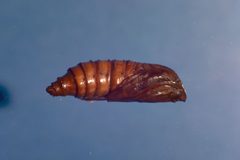
Females lay 350–500 singly along grapevines; many fall to the ground. Eggs hatch in approximately two weeks. First-instar larvae immediately burrow into soil and locate grapevine roots, where they feed for one year or more. When ready to pupate, larvae move to just below the soil surface and construct a pupal chamber. takes about one month. The pupa wriggles to the soil surface, and the emerges, leaving behind a pupal ('shell').
Behavior
females emit to attract males for mating. Adults are and -mimicking in , likely reducing . Larvae are subterranean root-borers that feed internally on grapevine root tissue. Larvae exhibit aggregated spatial distribution, concentrating near the bases of vines with decreasing with distance from the trunk.
Ecological Role
As a native insect, it originally played a role in natural feeding on wild grape . In agricultural contexts, it functions as a significant pest causing economic damage to grape . The species serves as prey for various natural enemies including birds, firefly larvae, and in the stage, and is susceptible to in the larval stage.
Human Relevance
Major economic pest of grape vineyards in the eastern United States, capable of reducing productivity by up to 47%. cause 'slow vine decline' with including wilting, discolored and stunted leaves, reduced shoot growth, and fewer, smaller grapes. Between 1967 and 1975, borers destroyed 300–350 acres of bunch grapes in South Carolina, causing many growers to abandon grape . Management options include monitoring traps, inspection of soil for pupal , cultural practices (soil mounding, plastic barriers), and using (Heterorhabditis bacteriophora, H. megidis). Chlorpyrifos is the primary option, though many growers avoid it due to concerns about soil biodiversity and wine quality. Scientists are exploring soil acoustics for detection of subterranean larvae.
Similar Taxa
- Polistes spp. (paper wasps) are Batesian mimics of Polistes ; distinguished by structure (filamentous vs. elbowed) and wing characteristics
- Other Sesiidae speciesOther clearwing moths share transparent wings; distinguished by specific association with grapevines and -mimic coloration pattern
- Phymatodes amoenusAnother grapevine-associated cerambycid beetle; distinguished by being a wood-borer in dead vines rather than root-borer, and by (hardened forewings, long )
More Details
Detection Difficulties
The is notoriously difficult to detect due to its subterranean larval stage and delayed aboveground . Vines may not show visible damage until 5–10 years of . This 'out of sight, out of mind' problem contributes to underestimation of its economic impact.
Spatial Variability
are highly spatially variable within and among vineyards, with severe infestations occurring adjacent to unaffected areas. This patchy distribution may contribute to lack of awareness and sporadic management attention.
Monitoring Methods
Three primary monitoring approaches exist: (1) destructive root inspection, (2) -baited traps for (effective but may attract males from long distances), and (3) soil inspection for pupal —the only unequivocal, nondestructive indicator of status. The latter requires maintaining a 1-meter diameter bare soil 'skirt' around vine bases during the 8+ week period.
Sources and further reading
- BugGuide
- Wikipedia
- GBIF taxonomy match
- iNaturalist taxon
- NCBI Taxonomy
- Catalogue of Life
- What Lies Beneath: Grape Root Borer in Eastern Vineyards
- Vitacea polistiformis Archives - Entomology Today
- New species of leafminer on grapevine in Western Cape came from wild grapes | Blog
- Uncategorized | Blog - Part 14
- Cerambycidae | Beetles In The Bush | Page 10
- Meet Enus’ Meal | Beetles In The Bush
- SEASONAL DISTRIBUTION AND EVALUATION OF TWO TRAP TYPES FOR MONITORING GRAPE ROOT BORER VITACEA POLISTIFORMIS (LEPIDOPTERA: SESIIDAE) IN FLORIDA VINEYARDS
- SUSCEPTIBILITY OF GRAPE ROOT BORER LARVAE, <i>VITACEA POLISTIFORMIS</i> (LEPIDOPTERA: SESIIDAE) TO <i>NEOAPLECTANA CARPOCAPSAE</i> (NEMATODA: RHABDITIDA): POTENTIAL OF HOST KAIROMONES FOR ENHANCEMENT OF NEMATODE ACTIVITY IN GRAPE VINEYARDS
- Models of the Distribution of Subterranean Stages of Vitacea polistiformis1 in Concord Grape Vineyards