
Vitacea
Engelhardt, 1946
Grape Root Borer Moths
Species Guides
4- Vitacea admirandus
- Vitacea cupressi
- Vitacea polistiformis(grape root borer)
- Vitacea scepsiformis(Lesser Grape Root Borer Moth)
Vitacea is a of clearwing moths in the Sesiidae, commonly known as . The genus contains four recognized , including Vitacea polistiformis, a significant agricultural pest of grape vineyards in the eastern United States. are mimics with reduced wing scaling that gives them a distinctive transparent appearance. Larvae are subterranean root borers that feed on grapevine roots, causing economically important damage to cultivated grapes.
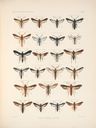
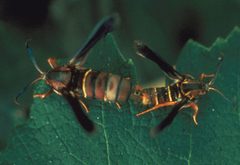
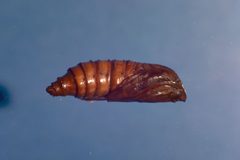
Pronunciation
How to pronounce Vitacea: /vɪˈteɪʃiə/
These audio files are automatically generated. While they are not always 100% accurate, they are a good starting point.
Identification
distinguished from other sesiid by combination of wing venation patterns, body coloration, and antennal structure. Vitacea polistiformis specifically identified by black body with yellow abdominal bands, transparent wings with dark brown borders, and -like pattern. Larvae identified by presence in grapevine roots and characteristic borer with well-developed . Pupal found at soil surface near vine bases provide diagnostic confirmation of .
Images
Appearance
are medium-sized sesiid with -like appearance due to reduced wing scaling creating transparent areas on forewings and hindwings. Body typically dark with yellow or orange markings. often thickened or clubbed. Wingspan approximately 25-35 mm. Larvae are creamy-white, cylindrical, legless borers with brown capsules, reaching 25-30 mm in length.
Habitat
occur in and around vineyards and areas with wild grape (Vitis) . Larval is subterranean, in soil surrounding grapevine root systems. Found in well-drained soils of eastern North American vineyards, from the root zone to depths of 30-60 cm depending on root distribution.
Distribution
Eastern North America, from Florida north to New York and west to Texas and Oklahoma. Distribution closely follows that of native and cultivated grape (Vitis). Individual species have more restricted ranges: V. polistiformis widespread in eastern U.S.; V. cupressi, V. scepsiformis, and V. admiranda have more limited documented distributions.
Seasonality
emerge from soil primarily June through September, with peak varying by latitude and local climate. In Florida, adult documented from May through October with peaks in July-August. Emergence period can extend 8 weeks or more at individual sites. Larvae present year-round in soil, with overlapping .
Diet
Larvae feed exclusively on roots of grape vines (Vitis spp.), including both cultivated varieties and native wild grapes. Feeding occurs on roots of all sizes, with preference for larger structural roots. do not feed; they rely on larval energy reserves.
Host Associations
- Vitis labrusca - Concord and other labrusca-type grapes; major commercial
- Vitis vinifera - European wine grapes; susceptible to
- Vitis rotundifolia - Muscadine grapes; native southeastern
- Vitis spp. - Wild grape serve as
Life Cycle
Females lay 350-500 singly on grapevine trunks, canes, or nearby vegetation. Eggs hatch in approximately two weeks; first instar larvae drop or crawl to soil and immediately burrow to roots. Larvae feed on roots for 1-2 years, passing through 5-6 instars. When mature, larvae move to soil surface just below ground level and construct pupal . lasts approximately one month. Pupa wriggles to soil surface and emerges, leaving pupal protruding from soil. Single per year in northern range, possibly partial second generation in southern range.
Behavior
are with -like , hovering near grapevines. Females emit to attract males from until mating. Mated females actively seek oviposition sites on grapevines. Adults are poor dispersers, typically moving less than 100 meters from emergence site. Larvae are sedentary borers, feeding within single root systems for extended periods.
Ecological Role
Larvae function as primary consumers of grapevine root tissue, capable of killing established vines through cumulative feeding damage. In natural with wild grapes, likely serves as prey for soil-dwelling and . serve as of minor significance while nectaring.
Human Relevance
Major economic pest of commercial grape production in eastern United States. Damage from V. polistiformis has caused vineyard abandonment in South Carolina and significant yield losses throughout range. Management relies on monitoring pupal , trapping, cultural controls (soil mounding, barriers), and . Chlorpyrifos historically used but increasingly restricted; with Heterorhabditis nematodes shows promise.
Similar Taxa
- MelittiaAnother sesiid with clearwing moths and root-boring larvae; distinguished by different wing venation and typically squash/cucurbit rather than grapes
- SynanthedonSesiid with similar -mimic appearance; larvae typically bore in woody stems and trunks rather than roots, and often have different color patterns
- PolistesPaper wasp that V. polistiformis mimic; distinguished by true characteristics including constricted waist, elbowed , and different wing structure
Misconceptions
frequently mistaken for paper wasps (Polistes) due to convergent mimicry, leading to unnecessary concern by vineyard . The name '' sometimes applied to other grape pests, but properly refers only to Vitacea polistiformis and related in this . Damage often attributed to other causes (drought, nutrient deficiency, other ) due to delayed aboveground symptom expression.
More Details
Taxonomic History
erected by Engelhardt in 1946 to accommodate previously placed in related sesiid genera. The four included species were described between 1854 and 1882, with V. polistiformis (Harris, 1854) being the type species.
Research Challenges
Subterranean larval habit makes assessment and research difficult. Larvae cannot be reliably sampled without destructive root excavation. Spatial distribution highly heterogeneous, with severe in one vineyard block and adjacent blocks unaffected.
Sources and further reading
- BugGuide
- Wikipedia
- GBIF taxonomy match
- iNaturalist taxon
- NCBI Taxonomy
- Catalogue of Life
- Vitacea polistiformis Archives - Entomology Today
- What Lies Beneath: Grape Root Borer in Eastern Vineyards
- New species of leafminer on grapevine in Western Cape came from wild grapes | Blog
- Uncategorized | Blog - Part 14
- Cerambycidae | Beetles In The Bush | Page 10
- Meet Enus’ Meal | Beetles In The Bush
- Models of the Distribution of Subterranean Stages of Vitacea polistiformis1 in Concord Grape Vineyards
- SEASONAL DISTRIBUTION AND EVALUATION OF TWO TRAP TYPES FOR MONITORING GRAPE ROOT BORER VITACEA POLISTIFORMIS (LEPIDOPTERA: SESIIDAE) IN FLORIDA VINEYARDS
- SUSCEPTIBILITY OF GRAPE ROOT BORER LARVAE, <i>VITACEA POLISTIFORMIS</i> (LEPIDOPTERA: SESIIDAE) TO <i>NEOAPLECTANA CARPOCAPSAE</i> (NEMATODA: RHABDITIDA): POTENTIAL OF HOST KAIROMONES FOR ENHANCEMENT OF NEMATODE ACTIVITY IN GRAPE VINEYARDS
- Phylogeographic history of Parthenocissus (Vitaceae) in North America based on chloroplast and nuclear DNA sequences.
- The complete chloroplast genome of Nekemias hypoglauca (Hance) J. Wen & Z. L. Nie 2014 (Family: Vitaceae) and its phylogenetic analysis.