
Vitacea scepsiformis
(Edwards, 1881)
Lesser Grape Root Borer Moth
Vitacea scepsiformis, the lesser grape root borer moth, is a clearwing moth in the Sesiidae. It occurs across eastern and central North America, where its larvae develop as root borers in grapevines (Vitis ). are active from mid-summer through early autumn and are mimics in appearance. The species is smaller than the related grape root borer (Vitacea polistiformis) and generally considered less economically damaging.
Pronunciation
How to pronounce Vitacea scepsiformis: /vɪˈtæs.iə skɛp.sɪˈfɔr.mɪs/
These audio files are automatically generated. While they are not always 100% accurate, they are a good starting point.
Identification
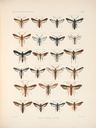
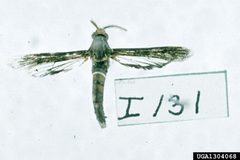
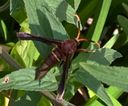
have a wingspan of approximately 23 mm. They exhibit typical sesiid clearwing moth with reduced wing scaling that creates transparent areas, giving a -like appearance. Distinguished from the larger grape root borer (Vitacea polistiformis, wingspan ~25-30 mm) by smaller size and more northerly distribution. Both share the characteristic narrow wasp-waisted body form and yellow-orange and dark coloration typical of sesiid wasp mimics.
Images
Habitat
Associated with vineyards and wild grape . Larvae occur underground, feeding within the roots of grape plants. are found in and around grape-growing areas.
Distribution
North America, from New York south to Florida and west to Texas, Kansas, and Missouri.
Seasonality
are on wing from July to October.
Diet
Larvae feed in the roots of Vitis (grapes).
Host Associations
- Vitis - larval larvae feed in roots
Human Relevance
A minor pest of cultivated grapes. Less damaging than Vitacea polistiformis; larvae feed in roots but densities and individual size generally result in reduced economic impact compared to the greater grape root borer.
Similar Taxa
- Vitacea polistiformisLarger congeneric grape root borer with similar and use; distinguished by larger size (wingspan ~25-30 mm vs. ~23 mm) and more southern distribution
Sources and further reading
- BugGuide
- Wikipedia
- GBIF taxonomy match
- iNaturalist taxon
- NCBI Taxonomy
- Catalogue of Life
- Vitacea polistiformis Archives - Entomology Today
- What Lies Beneath: Grape Root Borer in Eastern Vineyards
- New species of leafminer on grapevine in Western Cape came from wild grapes | Blog
- Uncategorized | Blog - Part 14
- Cerambycidae | Beetles In The Bush | Page 10
- Meet Enus’ Meal | Beetles In The Bush