
Phymatodes amoenus
(Say, 1824)
Grapevine Phymatodes
Phymatodes amoenus is a small to medium-sized longhorn beetle ( Cerambycidae) found in North America. The is commonly known as the grapevine phymatodes due to its exclusive association with grape vines (Vitis spp.). are typically found on dead grape vines, where they may occur alongside predatory checkered beetles (Cleridae) that prey upon their larvae. The species was first described by Thomas Say in 1824.

Pronunciation
How to pronounce Phymatodes amoenus: /faɪˈmætəˌdiːz əˈmɛnəs/
These audio files are automatically generated. While they are not always 100% accurate, they are a good starting point.
Identification
Phymatodes amoenus can be distinguished from other North American Phymatodes by its exclusive association with Vitis (grape) as a plant. Among the 26 species currently recognized in North America, P. amoenus is one of the more eastern species in distribution. Swift & Ray (2010) provide diagnostic photographs and comparative notes in their nomenclatural revision of the . The species may be confused with other small, dark Callidiini, but host plant association provides a strong clue to identity.
Images
Appearance
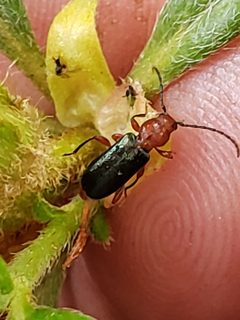
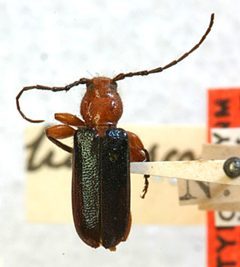
are small to medium-sized cerambycid beetles. Based on published habitus photographs, the body is somewhat cylindrical and moderately robust. Coloration appears variable, with specimens showing dark brown to blackish tones with possible lighter markings. The are of moderate length, not exceptionally elongated relative to the body. The are smooth to moderately sculptured. Detailed morphological descriptions are sparse in the accessible literature.
Habitat
Associated with dead grape vines (Vitis spp.) in forested or semi-open where grapes occur. The requires dead wood of its specific plant for larval development.
Distribution
North America; recorded from Canada (Ontario, Québec) and the United States. The exact extent of the U.S. range is not fully documented in available sources, but the appears to be primarily eastern in distribution.
Seasonality
have been observed in May. The timing of adult activity likely coincides with the availability of dead grape vine material and suitable conditions for adult .
Diet
Larvae develop within dead grape vines (Vitis spp.), feeding on the decaying wood. The specific nutritional (whether feeding primarily on wood or fungal material within the wood) has not been explicitly documented.
Host Associations
- Vitis - larval Exclusive association with grape vines; larvae develop in dead vines
Life Cycle
Complete (holometabolous). Larvae tunnel in dead grape vine wood, pupate within the wood, and emerge as . Specific details of developmental timing and number of per year are not documented in available sources.
Behavior
have been observed on dead grape vines, sometimes in association with predatory checkered beetles. When confined with checkered beetles (Enoclerus ichneumoneus), adults are vulnerable to , with documented instances of and leg segments being consumed.
Ecological Role
Human Relevance
The "grapevine phymatodes" suggests potential relevance to viticulture, though no specific economic impact has been documented in available sources. The is of interest to coleopterists studying -specificity in Cerambycidae.
Similar Taxa
- Phymatodes grandisFormerly P. lecontei, now synonymized; larger with different associations
- Other Phymatodes speciesMany in the are western in distribution and associated with different plants (e.g., oak, walnut); P. amoenus is distinguished by eastern distribution and exclusive Vitis association
- Other CallidiiniSmall, dark cerambycines may be similar in general appearance; plant association is key distinguishing feature
More Details
Taxonomic History
Originally described as Callidium amoenum by Thomas Say in 1824. Transferred to Phymatodes. The Phymatodes underwent significant nomenclatural revision by Swift & Ray (2010), though P. amoenus itself was not involved in synonymy changes.
Type Specimen
The original was described by Say in 1824; current depository not specified in available sources.
Observation Notes
A documented observation from Stoddard County, Missouri involved an found alongside Enoclerus ichneumoneus (checkered beetle) on dead grape vine. The two were collected together; the checkered beetle later preyed upon the cerambycid when confined in a vial, consuming half the left and left mesotarsus.
Sources and further reading
- BugGuide
- Wikipedia
- GBIF taxonomy match
- iNaturalist taxon
- NCBI Taxonomy
- Catalogue of Life
- Encyrtid Holdings | Entomology Research Museum
- Primary Type List | Entomology Research Museum
- Meloidae Holdings | Entomology Research Museum
- Cerambycidae | Beetles In The Bush | Page 10
- Nomenclatural changes in Phymatodes | Beetles In The Bush
- October | 2021 | Beetles In The Bush