
Synanthedon resplendens
(Edwards, 1881)
Sycamore Borer Moth
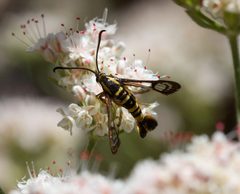
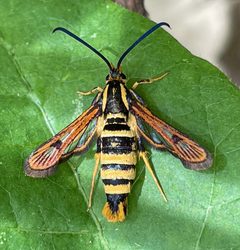
A clearwing moth ( Sesiidae) native to western North America. exhibit -mimicry with yellow and black coloration and transparent wings. Larvae are bark miners, primarily infesting sycamore and oak trees. Despite extensive tunneling, damage is generally considered minor and trees tolerate well.
Pronunciation
How to pronounce Synanthedon resplendens: /sɪˈnænθɪˌdɒn rɪˈsplɛndənz/
These audio files are automatically generated. While they are not always 100% accurate, they are a good starting point.
Identification
Distinguished from other clearwing moths by combination of: yellow and black -mimic coloration with transparent wings; blue-black with parallel yellow lateral lines; specific association with sycamore and oak ; round holes 3–6 mm in diameter in bark cracks. Similar Synanthedon mellinipennis (ceanothus clearwing) overlaps in range and host plants, but S. resplendens can be separated by details of color pattern and host preference. Pupal skins may protrude from emergence holes.
Images
Habitat
Associated with trees in riparian areas, woodlands, and urban landscapes. Larval galleries occur primarily at base and lower trunk, occasionally up to 9 m above ground. Favors old, slow-growing trees and injured tissues for oviposition.
Distribution
Western North America: throughout California, north to Yukon, east to New Mexico. Nearctic distribution.
Seasonality
active May through early August, with peak in June and July. One per year. Adults live approximately one week.
Diet
Larvae feed beneath bark of trees, mining serpentine tunnels in phloem. Rarely damage cambium or feed in wood. Hosts: sycamore (Platanus racemosa, P. wrightii, P. occidentalis), coast live oak (Quercus agrifolia), and likely many western oaks; also ceanothus (Ceanothus spp.) and rarely avocado (Persea americana).
Host Associations
- Platanus racemosa - larval California sycamore
- Platanus wrightii - larval Arizona sycamore
- Platanus occidentalis - larval American sycamore
- Quercus agrifolia - larval Coast live oak; confirmed
- Quercus spp. - larval Likely many or most other western oaks
- Ceanothus spp. - larval Ceanothus
- Persea americana - larval Avocado; rare occurrence
Life Cycle
One annually. occurs as larvae or pupae within bark tunnels. laid singly on bark in cracks or depressions. Larvae mine bark below surface, creating serpentine tunnels; expel reddish sawdust-like from tunnels. occurs just below bark surface; pupal skins protrude through bark at . Adults emerge through round holes 3–6 mm in diameter.
Behavior
exhibit -mimicry : intermittent rapid running and fluttering of wings reminiscent of vespid wasps. Adults not attracted to lights. laid singly on bark, not in clusters.
Ecological Role
Bark-mining insect; contributes to nutrient cycling through phloem feeding. Creates entry points for other organisms. Generally minor ecological impact; trees tolerate extensive boring.
Human Relevance
Considered a minor pest of ornamental and native trees. Superficial damage may be deemed unsightly, but control generally not recommended as sycamores tolerate extensive boring. Occasional concern in avocado orchards (rare ).
Similar Taxa
- Synanthedon mellinipennisCeanothus clearwing; overlaps in range and uses similar plants. Separable by color pattern details and host preference nuances.
More Details
Signs of Infestation
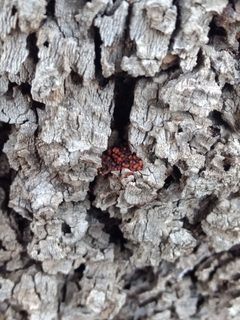
Reddish sawdust-like accumulates in branch crotches or on ground below infested area. Outer bark over tunnels becomes roughened after repeated and may produce wet ooze. Tunnels can extend over 100 cm² in area.
Diurnal Activity
are and not attracted to lights, making them difficult to encounter except by direct observation or lures.