
Synanthedon helenis
(Engelhardt, 1946)
Helenis clearwing
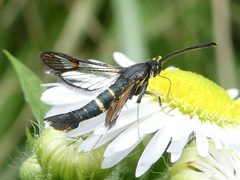
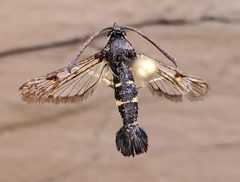
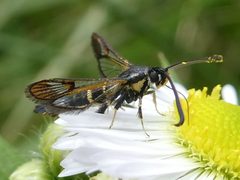
Synanthedon helenis is a clearwing moth in the Sesiidae, distributed across the Canadian Prairie Provinces. The exhibits typical sesiid characteristics including reduced wing scaling that creates a transparent, -like appearance. Like many clearwing moths, it is primarily and not attracted to lights. The specific plants and larval remain poorly documented.
Pronunciation
How to pronounce Synanthedon helenis: //sɪˌnænˈθiː.dɒn hɛˈleː.nɪs//
These audio files are automatically generated. While they are not always 100% accurate, they are a good starting point.
Identification
Clearwing moths in the Synanthedon are distinguished from similar by specific wing venation patterns and genitalia , though -level identification typically requires examination of these characters. S. helenis occurs in a region where it may overlap with other Synanthedon species; precise identification relies on reference to the original description and type locality. The species lacks the pronounced in structure seen in some related genera such as Euhagena.
Images
Habitat
Prairie and parkland regions of the Canadian Prairie Provinces; specific microhabitat preferences are undocumented.
Distribution
Alberta, Manitoba, and Saskatchewan, Canada. Distribution records are sparse and based on limited collection data.
Behavior
Primarily ; not attracted to artificial lights.
Similar Taxa
- Euhagena nebraskaeOverlaps regionally; distinguished by pronounced in male (bipectinate in Euhagena versus simpler structure in Synanthedon) and different wing scaling patterns.
- Synanthedon acerniOccurs in overlapping regions and has been documented at blacklights, unlike most clearwing moths; distinguished by specific wing pattern and association with maple.
- Synanthedon scitulaOverlaps in eastern North American range; distinguished by wing pattern and plant specificity.