
Synanthedon exitiosa
(Say, 1823)
peachtree borer, Peachtree Borer Moth
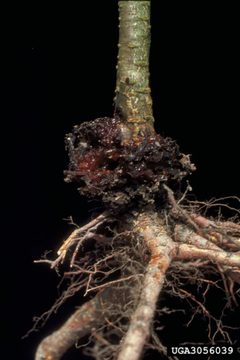
Synanthedon exitiosa, commonly known as the peachtree borer, is a clearwing moth native to North America and a significant pest of stone fruit trees. The exhibits pronounced in both size and wing appearance. Larvae bore into the trunks and root crowns of Prunus species, feeding on cambium and phloem tissue, often causing tree death. females use cues, including compounds from larval gum , to locate suitable oviposition sites.
Pronunciation
How to pronounce Synanthedon exitiosa: /sɪˌnænˈθiːdɒn ɛkˈsɪtɪoʊsə/
These audio files are automatically generated. While they are not always 100% accurate, they are a good starting point.
Identification
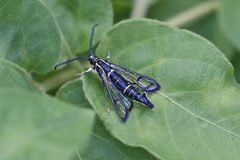
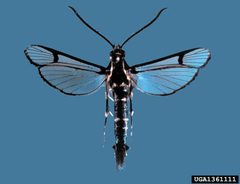
Distinguished from similar clearwing moths by association with Prunus and specific coloration: dark metallic blue body with orange abdominal band in females. Males with fully clear wings may resemble other sesiid species but can be separated by association with peach/cherry and, when captured, by genitalia or molecular identification.
Images
Habitat
Orchards and natural stands of Prunus ; larvae occur in trunks and root crowns of trees, found near host tree bases where oviposition occurs.
Distribution
Native to North America; recorded from Canada (Manitoba) and throughout the United States in regions where Prunus occur. GBIF records indicate presence in Nearctic and Neotropical regions, though primary distribution is temperate North America.
Diet
Larvae feed on cambium and phloem tissue of Prunus including peach (Prunus persica), cherry, and apricot. do not feed.
Host Associations
- Prunus persica - larval peach; primary cultivated
- Prunus - larval including cherry and apricot
Life Cycle
laid around base of tree trunk. Larvae bore into trunk and feed on cambium and phloem, producing gum (mixture of phloem particles, sap, and ). Larval development occurs within tree; presumably occurs in or near gallery (specific pupation site not documented in sources). emerge and mate; females oviposit using cues from gum frass to identify suitable host trees.
Behavior
are and generally not attracted to lights. Females use -mediated oviposition , responding to volatile compounds from larval gum to select oviposition sites. Males have been observed at blacklights on occasion, though this is atypical for the group.
Ecological Role
As a herbivore on Prunus, larvae act as cambium borers that can kill trees. Gum production by larvae creates signals that mediate female oviposition decisions, potentially facilitating on suitable hosts.
Human Relevance
Major economic pest of commercial peach, cherry, and apricot . Larval boring damage often kills trees. Research has focused on -based management tactics as alternatives to conventional applications.
Similar Taxa
- Synanthedon acerniAnother North American Synanthedon ; distinguished by association (Acer vs. Prunus) and may be separated by genitalia or molecular data
- Synanthedon scitulaAnother North American Synanthedon ; associations and geographic overlap require careful separation, possibly by genitalia or molecular methods
- Synanthedon fatiferaBores into Viburnum crowns rather than Prunus; plant association is primary distinguishing feature
More Details
Semiochemical research
Studies have identified 21 compounds from gum that elicit antennal responses, including acids, hydrocarbons, ketones, acetates, aldehydes, and specific compounds such as γ-decalactone, conophthorin, and 2-isopropyl-3-methoxypyrazine. These compounds, with the exception of acetates, are required to induce oviposition in laboratory assays.
Sexual dimorphism in antennal structure
Males possess highly bipectinate (feathery) , a trait common in clearwing moths that aids in detecting female .