
Eichlinia calabaza
(Duckworth & Eichlin, 1973)
Southwestern Squash Vine Borer
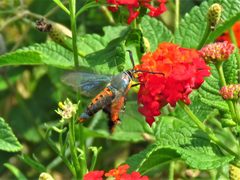
Eichlinia calabaza is a clearwing moth in the Sesiidae, commonly known as the Southwestern Squash Vine Borer. It occurs in the southwestern United States and northern Mexico, where its larvae develop within the stems of wild and cultivated cucurbits. The is a significant agricultural pest of squash, pumpkins, and related crops. are and -mimicking in appearance.
Pronunciation
How to pronounce Eichlinia calabaza: /aɪkˈlɪniə ˌkæləˈbɑːzə/
These audio files are automatically generated. While they are not always 100% accurate, they are a good starting point.
Identification
Distinguished from other squash vine borers (Melittia ) by geographic range: E. calabaza occurs in the Southwest, while Melittia cucurbitae is eastern and central. E. calabaza has more extensive dark wing margins and more pronounced abdominal banding than many clearwing moths. can be separated from by the presence of on wing edges and simple (not elbowed) . Larvae identified by plant association and presence within cucurbit stems.
Images
Habitat
Arid and semi-arid regions including desert scrub, grasslands, and agricultural areas. Associated with riparian corridors and irrigated fields where plants grow. Elevational range from low desert to moderate foothills.
Distribution
Southwestern United States (Arizona, New Mexico, southern California, southern Nevada, western Texas) and northern Mexico (Sonora, Chihuahua, Baja California). Range overlaps and may intergrade with related in some areas.
Seasonality
active primarily from late spring through summer, with peak activity June–August in most of range. Multiple per year in warmer areas; single generation in higher elevations or northern parts of range. Larval feeding occurs from late spring through fall.
Diet
Larvae feed internally on stems and vines of Cucurbitaceae, including wild cucurbits (Cucurbita foetidissima, C. digitata) and cultivated (Cucurbita pepo, C. maxima, C. moschata). do not feed; may take nectar from flowers.
Host Associations
- Cucurbita foetidissima - larval wild buffalo gourd
- Cucurbita digitata - larval wild fingerleaf gourd
- Cucurbita pepo - larval cultivated squash, pumpkin, zucchini
- Cucurbita maxima - larval cultivated winter squash
- Cucurbita moschata - larval cultivated butternut squash
Life Cycle
laid singly or in small groups on stems or petioles of plants. Larvae bore into stems, feeding internally and causing wilting or plant death. Larval development takes 2–4 weeks. Mature larvae exit stems and pupate in soil. Pupal may occur; emerge following spring or summer rains that stimulate host plant growth.
Behavior
are and active during daylight hours. rapid and direct, -like, with quick wing beats. Adults often visit flowers for nectar. Females locate plants by chemical cues. Larvae feed gregariously within stems when multiple occur, though individual larvae maintain separate tunnels.
Ecological Role
Larval herbivore that can kill plants by girdling stems. Serves as prey for and . Pollination role of minimal. In natural systems, regulated by host plant availability and natural enemies.
Human Relevance
Significant agricultural pest of squash and pumpkin production in the Southwest. Economic damage from larval tunneling includes reduced yields, plant death, and secondary . Management relies on , , , and varieties. Wild gourds serve as .
Similar Taxa
- Melittia cucurbitaeEastern squash vine borer; distinguished by distribution (eastern/central North America), slightly larger size, and less pronounced abdominal banding.
- Eichlinia snowiiRelated clearwing moth; distinguished by paler wing margins and more restricted distribution in the Great Basin and Rocky Mountain regions.
- Synanthedon spp.Other clearwing moths; distinguished by different associations (often woody plants) and generally smaller size with different color patterns.
More Details
Taxonomic History
Originally described as Melittia calabaza by Duckworth & Eichlin in 1973. Transferred to Eichlinia by Eichlin & Duckworth in 1998 to accommodate North American clearwing moths formerly placed in Melittia. Genus name honors John B. Eichlin, in Sesiidae.
Pest Management
Cultural controls include destroying to eliminate larvae and using floating to exclude -laying females. Chemical controls target eggs and young larvae; established larvae are protected within stems. using shows promise but is not widely adopted.