
Givira lucretia
Barnes & McDunnough, 1913
Pronunciation
How to pronounce Givira lucretia: //dʒɪˈvɪrə luːˈkriːti.ə//
These audio files are automatically generated. While they are not always 100% accurate, they are a good starting point.
Identification
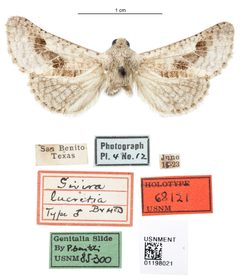
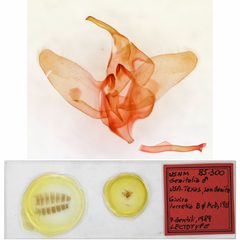
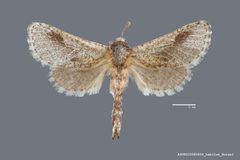
Differs from the related white-winged Givira delindae (described from White Sands, New Mexico) by geographic range and presumably by wing pattern; G. lucretia has a darker, more typical cossid appearance compared to the pale, nearly unmarked wings of G. delindae. Separation from other small North American Hypoptinae requires examination of genitalic .
Images
Appearance
Small with wingspan 23–28 mm. Specific coloration and pattern details not documented in available sources.
Habitat
Arid and semi-arid environments. Recorded from gypsum dune systems and adjacent desert scrub in Wyoming, Texas, and Arizona.
Distribution
United States: Arizona, Texas, and Wyoming.
Seasonality
active April through August; multivoltine or with extended period.
Similar Taxa
- Givira delindaeAlso a small white-winged Givira from the southwestern US, but G. delindae is nearly pure white with satiny wings and restricted to White Sands, New Mexico; G. lucretia has darker coloration and broader distribution.
- Other Givira speciesMost North American relatives are dark-colored or have substantial dark smudges on forewings; four including G. lucretia are substantially white with few or no dark markings.
More Details
Taxonomic note
The Givira belongs to Hypoptinae within Cossidae, a group commonly known as carpenter millers or goat moths. The name honors an individual, following the pattern of related species epithets in this genus.