
Sphinx sequoiae
Boisduval, 1868
Sequoia Sphinx
Sphinx sequoiae is a small sphinx moth native to western North America, ranging from Oregon through California, Nevada, Utah, Arizona, and into northern Baja California. It is the smallest in its besides Sphinx dollii, with which it is sometimes confused despite occupying different geographic ranges. The species completes one annually, with active from May through August.
Pronunciation
How to pronounce Sphinx sequoiae: //sfiŋks sɛˈkwɔ.i.aɪ//
These audio files are automatically generated. While they are not always 100% accurate, they are a good starting point.
Identification
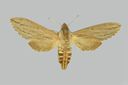
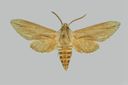
Distinguished from other Sphinx by its small size (second smallest in ), ash-gray coloration with black dashes on forewings, and geographic range. May be confused with Sphinx dollii, but that species occupies different regions. The pointed forewings and monotone hindwings separate it from many with more patterned wings.
Images
Habitat
Particularly common in juniper and cedar forests, including those east of the Cascade Range in the Pacific Northwest. Associated with coniferous woodland in arid and semi-arid regions of the western United States and adjacent Mexico.
Distribution
Western North America from Oregon south through California, Nevada, south-eastern Utah, Arizona, and into northern Baja California, Mexico.
Seasonality
Single per year; fly from May through August. activity pattern.
Diet
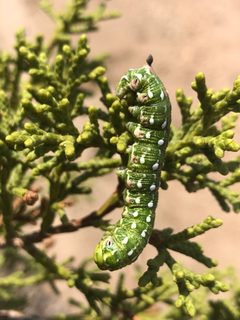
feed on nectar from flowers of western chokecherry (Prunus virginiana) and California buckeye (Aesculus californica). Larvae feed on California juniper (Juniperus californica), Utah juniper (Juniperus osteosperma), and California incense cedar (Calocedrus decurrens).
Host Associations
- Juniperus californica - larval California juniper
- Juniperus osteosperma - larval Utah juniper
- Calocedrus decurrens - larval California incense cedar
- Prunus virginiana - nectar sourcewestern chokecherry
- Aesculus californica - nectar sourceCalifornia buckeye
Life Cycle
Single per year. are laid and hatch into larvae that feed on conifers. Larvae pupate in soil or debris. emerge May through August, with the in the pupal stage.
Behavior
are and attracted to light. They exhibit typical sphinx moth hovering when feeding at flowers. Larvae are solitary feeders on foliage.
Ecological Role
serve as of their nectar plants. Larvae are herbivores that consume foliage of juniper and cedar , contributing to nutrient cycling in coniferous woodland . The species is part of the supporting of sphinx moths.
Human Relevance
Minor significance. may be observed at porch lights. Not known to be an agricultural or forestry pest. The was first described by Jean Baptiste Boisduval in 1868.
Similar Taxa
- Sphinx dolliiSimilar small size and sometimes confused with S. sequoiae, but occupies different geographic regions
- Sphinx chersisLarger congeneric sphinx moth with different wing pattern and coloration
More Details
Taxonomic history
First described by French entomologist Jean Baptiste Boisduval in 1868.
Etymology
Specific epithet 'sequoiae' refers to the giant sequoia (Sequoiadendron giganteum), though the is not specifically associated with that tree; rather, it reflects the coniferous forest of the Sierra Nevada region.
Sources and further reading
- BugGuide
- Wikipedia
- GBIF taxonomy match
- iNaturalist taxon
- NCBI Taxonomy
- Catalogue of Life
- The Hornworms Are Not Your Friends | Bug Squad
- Don't Miss Bohart Museum Open House on Nov. 2 | Bug Squad
- Bug Eric: White-lined Sphinx ("Hummingbird Moth")
- For Ash-Dependent Insects, Some Plants Make Good Alternatives—But Others Don't
- Bug Eric: Moth Week and "Mothapalooza"
- Bug Eric: National Moth Week Recap, 2015