
Sphinx libocedrus
Edwards, 1881
Incense Cedar Sphinx
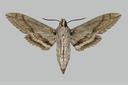
Sphinx libocedrus, the incense cedar sphinx, is a hawkmoth in the Sphingidae first described by Henry Edwards in 1881. The occurs from western Texas through New Mexico and Arizona to southern California, extending south into Mexico including Sonora and Baja California Sur. Larvae feed on specific plants in the olive family (Oleaceae), including New Mexican forestiera, Forestiera angustifolia, and Goodding's ash.


Pronunciation
How to pronounce Sphinx libocedrus: /ˈsfɪŋks laɪboʊˈsɛdrəs/
These audio files are automatically generated. While they are not always 100% accurate, they are a good starting point.
Identification
The can be distinguished from similar Sphinx moths by its geographic range and larval plant associations. Two are recognized: S. l. libocedrus (western Texas to southern California and Mexico) and S. l. achotla (Mexico).
Images
Distribution
Western Texas to southern California and Mexico, including Sonora and Baja California Sur. The S. l. achotla occurs in Mexico.
Diet
Larvae feed on New Mexican forestiera (Forestiera neomexicana), Forestiera angustifolia, and Goodding's ash (Fraxinus gooddingii), all in the olive (Oleaceae). feeding habits are not documented.
Host Associations
- Forestiera neomexicana - larval food plantNew Mexican forestiera, in Oleaceae
- Forestiera angustifolia - larval food plantIn Oleaceae
- Fraxinus gooddingii - larval food plantGoodding's ash, in Oleaceae
Similar Taxa
- Sphinx chersisBoth are Sphinx moths; S. chersis is the great ash sphinx, also associated with ash trees but with broader distribution
- Sphinx kalmiaeBoth are Sphinx moths with similar ; S. kalmiae has different plant associations and geographic range
More Details
Subspecies
Two are recognized: Sphinx libocedrus libocedrus (western Texas west through New Mexico and Arizona to southern California, south to Sonora and Baja California Sur) and Sphinx libocedrus achotla Mooser, 1944 (Mexico).
Sources and further reading
- BugGuide
- Wikipedia
- GBIF taxonomy match
- iNaturalist taxon
- NCBI Taxonomy
- Catalogue of Life
- The Hornworms Are Not Your Friends | Bug Squad
- Don't Miss Bohart Museum Open House on Nov. 2 | Bug Squad
- Bug Eric: White-lined Sphinx ("Hummingbird Moth")
- For Ash-Dependent Insects, Some Plants Make Good Alternatives—But Others Don't
- Bug Eric: Moth Week and "Mothapalooza"
- Bug Eric: National Moth Week Recap, 2015