
Sphinx gordius
Cramer, 1780
apple sphinx
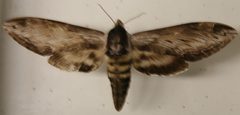
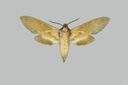
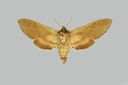
Sphinx gordius, commonly known as the apple sphinx, is a in the Sphingidae first described by Pieter Cramer in 1780. It is a medium to large sphinx moth with a wingspan ranging from 68–108 mm. The is distributed across northern North America, primarily east of the Rocky Mountains, with extending south along the Atlantic coast to Florida and westward through the Rocky Mountains to Colorado.
Pronunciation
How to pronounce Sphinx gordius: /ˈsfɪŋks ˈɡɔrdiəs/
These audio files are automatically generated. While they are not always 100% accurate, they are a good starting point.
Identification
Sphinx gordius can be distinguished from similar sphinx moths by its distribution range and association with specific larval plants. The S. g. oslari, restricted to Colorado, may show regional variation. may be confused with other Sphinx , but the combination of geographic location and forewing pattern can aid identification. Larvae feed on Malus, Rosa, Vaccinium, and Fraxinus, which can help distinguish them from hornworms (Manduca spp.) that specialize on Solanaceae.
Images
Habitat
Found in northern temperate regions of North America, primarily in areas supporting its larval plants: apple (Malus), rose (Rosa), blueberry (Vaccinium), and ash (Fraxinus). Occurs in forested and semi-open where these plants grow, including orchards, woodland edges, and shrublands.
Distribution
Northern United States and southern Canada, mostly east of the Rocky Mountains. Range extends along the Atlantic coast south to Florida and through the Rocky Mountains west to Colorado. S. g. oslari occurs in Colorado.
Diet
Larvae feed on Malus (apple), Rosa (rose), Vaccinium (blueberry), and Fraxinus (ash) . feeding habits are not documented in available sources.
Host Associations
- Malus - larval food plant
- Rosa - larval food plant
- Vaccinium - larval food plant
- Fraxinus - larval food plant
Similar Taxa
- Manduca sexta (tobacco hornworm)Larvae resemble hornworms but feed on different plants; Manduca spp. specialize on Solanaceae (tomato, tobacco, pepper) rather than the Rosaceae, Ericaceae, and Oleaceae hosts of S. gordius.
- Manduca quinquemaculata (tomato hornworm)Similar larval but distinct plant preferences; feed on Solanaceae, not the apple, rose, blueberry, and ash hosts of S. gordius.
More Details
Subspecies
Two are recognized: Sphinx gordius gordius (nominate subspecies) and Sphinx gordius oslari Rothschild & Jordan, 1903, which is restricted to Colorado.
Sources and further reading
- BugGuide
- Wikipedia
- GBIF taxonomy match
- iNaturalist taxon
- NCBI Taxonomy
- Catalogue of Life
- The Hornworms Are Not Your Friends | Bug Squad
- BioDivDay: Can't Wait to See You! | Bug Squad
- Don't Miss the Nematodes at UC Davis Biodiversity Museum Day | Bug Squad
- Right This Way to the UC Davis Nematode Collection! | Bug Squad
- Nematode Booth Wows Crowd at UC Davis Biodiversity Museum Day | Bug Squad
- Bug Eric: White-lined Sphinx ("Hummingbird Moth")