
Sphinx canadensis
Boisduval, 1875
Canadian sphinx
Sphinx canadensis, the Canadian sphinx, is a in the Sphingidae first described by Jean Baptiste Boisduval in 1875. It is an ash- whose larvae feed exclusively on black ash (Fraxinus nigra). are notable for flying later in the year than most other sphinx moth species, with peak activity in late July and early August. The species is frequently confused with the hermit sphinx (Sphinx eremitus) in areas where their ranges overlap.
Pronunciation
How to pronounce Sphinx canadensis: /ˈsfɪŋks ˌkænəˈdɛnsɪs/
These audio files are automatically generated. While they are not always 100% accurate, they are a good starting point.
Identification
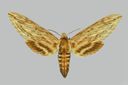
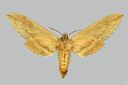
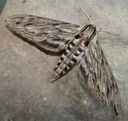
Distinguished from the hermit sphinx (Sphinx eremitus) by the absence of a white spot on the forewing—a feature consistently present in S. eremitus. The combination of gray-brown forewings with black streaks along and white marginal lines, plus black-and-white banded hindwings, provides diagnostic field marks. The black lateral patches on larvae are thought to mimic the curled leaves of black ash.
Images
Appearance
have a wingspan of 70–85 mm. The forewing is gray-brown with black streaks along the , interrupted by white lines along the outer margin. The hindwing displays a pattern of black and white bands. Unlike the similar Sphinx eremitus, this lacks a white spot on the forewing. Larvae have distinctive black patches on their sides.
Habitat
Associated with swamp edges and moist where black ash (Fraxinus nigra) grows. The larval plant occurs at wetland margins and in riparian zones.
Distribution
Northeastern United States and Canada, ranging north to Newfoundland and Labrador. Present in Vermont and throughout the northeastern region.
Seasonality
fly predominantly in very late July and early August, notably later than most other sphinx moth .
Diet
Larvae feed exclusively on black ash (Fraxinus nigra). nectar on Phlox and bouncing bet (Saponaria officinalis).
Host Associations
- Fraxinus nigra - larval sole confirmed larval plant; grows at swamp edges
- Fraxinus americana - larval previously thought to be used but recent observations refute this
- Vaccinium - larval previously thought to be used but recent observations refute this
- Phlox - nectar sourcepreferred nectar source
- Saponaria officinalis - nectar sourcepreferred nectar source; bouncing bet
Life Cycle
Complete with , larva, pupa, and stages. Larvae burrow into soil to pupate. Adults emerge in late summer. Specific details of stage and number of per year are not documented in available sources.
Behavior
are or in activity pattern. Larvae display cryptic coloration with black lateral patches that appear to mimic curled black ash leaves. Adults fly later in the season than , suggesting possible temporal isolation from related .
Ecological Role
herbivore dependent on black ash, making it vulnerable to ash tree decline from emerald ash borer and other threats. As an ash-specialist, it contributes to nutrient cycling in wetland forest and serves as prey for and other natural enemies.
Human Relevance
Subject of ecological concern due to dependence on ash trees threatened by emerald ash borer (Agrilus planipennis). Used as a study for understanding impacts of ash decline on dependent Lepidoptera. Occasionally attracted to lights.
Similar Taxa
- Sphinx eremitusOverlapping range and similar appearance; distinguished by presence of white spot on forewing in S. eremitus (absent in S. canadensis)
Misconceptions
Previously believed to have broader plant range including white ash and blueberry, but recent observations confirm exclusive specialization on black ash.
More Details
Taxonomic history
First described by Jean Baptiste Boisduval in 1875. The epithet canadensis reflects its northern distribution in Canada.
Conservation context
As an ash-dependent , this potential impacts from widespread ash mortality caused by emerald ash borer invasion across North America.
Sources and further reading
- BugGuide
- Wikipedia
- GBIF taxonomy match
- iNaturalist taxon
- NCBI Taxonomy
- Catalogue of Life
- The Hornworms Are Not Your Friends | Bug Squad
- Pieridae | Beetles In The Bush
- Bug Eric: White-lined Sphinx ("Hummingbird Moth")
- For Ash-Dependent Insects, Some Plants Make Good Alternatives—But Others Don't
- Bug Eric: Spider Sunday: Red Velvet Jumper
- Bug Eric: Moth Week and "Mothapalooza"