
Manduca lanuginosa
(Edwards, 1887)
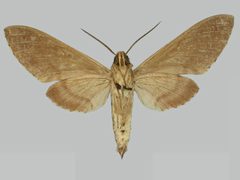
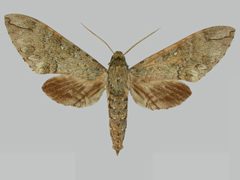
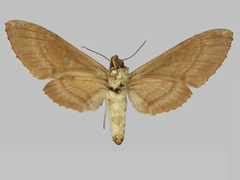
Manduca lanuginosa is a sphinx moth ( Sphingidae) first described by Henry Edwards in 1887. The is distributed across Central America and northern South America, with records from Mexico through Venezuela. have a wingspan of 86–104 mm. Like other members of the Manduca, the larvae are likely hornworms, though specific details about this species' remain poorly documented compared to the well-studied M. sexta and M. quinquemaculata.
Pronunciation
How to pronounce Manduca lanuginosa: /mænˈduːkə lænjuːdʒəˈnoʊsə/
These audio files are automatically generated. While they are not always 100% accurate, they are a good starting point.
Identification
Manduca lanuginosa can be distinguished from other Manduca by its documented distribution in Central America and northern South America, overlapping with but potentially extending beyond the ranges of better-known . The specific wing patterns and body distinguishing it from similar species such as M. sexta or M. quinquemaculata are not detailed in available sources. Accurate identification likely requires examination of genitalia or other subtle morphological features typical of sphinx moth .
Images
Appearance
have a wingspan of 86–104 mm. As a member of Manduca, adults likely have robust, streamlined bodies typical of sphinx moths, with narrow, pointed forewings and broader hindwings. The specific coloration and pattern of M. lanuginosa has not been detailed in the provided sources.
Distribution
Mexico, Belize, Honduras, Nicaragua, Rica, and Venezuela.
Similar Taxa
- Manduca sextaBoth are large sphinx moths in the same , but M. sexta is primarily distributed in North America and is a well-known agricultural pest, whereas M. lanuginosa occurs further south in Central and South America.
- Manduca quinquemaculataSimilar size and general appearance as a congeneric sphinx moth, but M. quinquemaculata is a North American with distinct larval markings (eight V-shaped white markings) not documented for M. lanuginosa.
More Details
Taxonomic history
The was originally described as Diludia lanuginosa by Henry Edwards in 1887, and later transferred to the Manduca.
Research status
M. lanuginosa has received limited scientific attention compared to the extensively studied M. sexta, which serves as a major model organism for insect physiology, neurobiology, and developmental .
Sources and further reading
- BugGuide
- Wikipedia
- GBIF taxonomy match
- iNaturalist taxon
- NCBI Taxonomy
- Catalogue of Life
- The Hornworms Are Not Your Friends | Bug Squad
- California Dogface Butterfly Steals the Show | Bug Squad
- Insect FAQs | Entomology Research Museum
- Tough to be a hornworm: Tomato and tobacco hornworms, Manduca quinquemaculata and M. sexta — Bug of the Week
- Advanced Morphology Techniques Reveal Tobacco Hornworm's Secrets
- Scientists Sequence the Genome of the Tobacco Hornworm