
Eupyrrhoglossum sagra
Poey, 1832
Cuban Sphinx
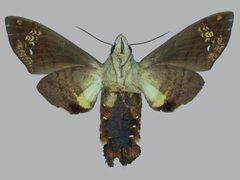
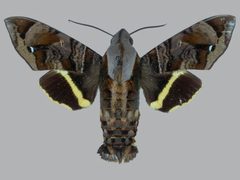
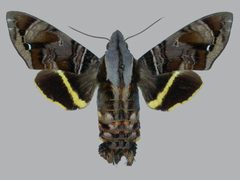
Eupyrrhoglossum sagra is a medium-sized sphinx moth (Sphingidae) native to tropical and subtropical lowlands of the Caribbean and Central and South America. have a wingspan of 51–53 mm and display distinctive wing patterning including a semi-transparent submarginal spot on the forewing and a yellow band on the hindwing. The was first described by Felipe Poey in 1832 based on Cuban specimens. Larvae feed on Rubiaceae species, with documented including Guettarda and Chomelia.
Pronunciation
How to pronounce Eupyrrhoglossum sagra: /juˌpɪ.roʊˈglɒsəm ˈsæɡrə/
These audio files are automatically generated. While they are not always 100% accurate, they are a good starting point.
Identification
Distinguished from similar sphinx moths by the combination of: semi-transparent submarginal spot on forewing; pale grey with sharply contrasting dark brown edges and line; and median yellow band of nearly even width on hindwing upperside. The low medial crest on the and yellow fringe are additional supporting characters.
Images
Appearance
Wingspan 51–53 mm. with low medial crest. pale grey, sharply contrasting with dark brown edges and line. Forewing upperside with blackish subbasal band and semi-transparent submarginal spot. Hindwing upperside with median yellow band of nearly even width. Fringe yellow.
Habitat
Tropical and subtropical lowlands. Specific microhabitat preferences are not documented.
Distribution
Cuba; Mexico; Belize; Guatemala; Rica; Bolivia; Paraguay; Argentina; Uruguay. Occasional strays recorded in Florida, USA.
Seasonality
probably active year-round in tropical regions. In Rica, adults recorded in all months except March. In Venezuela, adults recorded in April.
Diet
Larvae feed on Rubiaceae : Guettarda macrosperma, Guettarda scabra, and Chomelia spinosa. feeding habits are not documented.
Host Associations
- Guettarda macrosperma - larval Rubiaceae
- Guettarda scabra - larval Rubiaceae
- Chomelia spinosa - larval Rubiaceae
Life Cycle
Complete with , larva, pupa, and stages. Specific details of development duration and number of per year are not documented.
Behavior
are fliers. Specific behavioral observations beyond activity patterns are not documented.
Human Relevance
Occasional strays reach Florida, where the may be encountered by observers and collectors. No documented economic or agricultural significance.
Similar Taxa
- Other Eupyrrhoglossum speciesWithin the same ; E. sagra distinguished by specific wing pattern elements including the semi-transparent submarginal spot and thoracic coloration
- Other Dilophonotini sphinx mothsShare general body plan and size; E. sagra identified by the combination of pale grey with dark contrasting edges, specific yellow hindwing band, and forewing spot
More Details
Taxonomic history
Originally described as Macroglossum sagra by Felipe Poey in 1832, later transferred to Eupyrrhoglossum.
Observation frequency
iNaturalist records 238 observations, indicating the is encountered with moderate frequency within its range.