
Automeris louisiana
Ferguson & Brou, 1981
Louisiana eyed silkmoth
Automeris louisiana, the Louisiana eyed silkmoth, is a of giant silkmoth in the Saturniidae. It is native to North America and was described by Ferguson and Brou in 1981. Like other members of the Automeris, are characterized by prominent eyespots on the hindwings used for deterrence. The species has been subject to a petition for listing under the U.S. Act, with a status review initiated in 2011.
Pronunciation
How to pronounce Automeris louisiana: //ˌɔːtəˈmɛrɪs luˌiːziˈænə//
These audio files are automatically generated. While they are not always 100% accurate, they are a good starting point.
Identification
Distinguished from other Automeris by geographic distribution centered on Louisiana and adjacent Gulf Coast regions, combined with specific wing pattern elements. The eyespot configuration and forewing coloration differ from the more widespread Automeris io (Io moth), which has declined in parts of its range. Accurate identification may require examination of genitalia or molecular markers. The MONA/Hodges number 7749.1 provides a standardized reference for North American Lepidoptera.
Images
Appearance
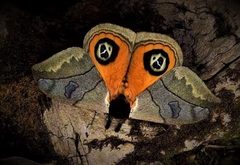
possess large, rounded wings with cryptic brownish forewings that provide camouflage against vegetation. When disturbed, the reveals striking hindwings bearing large, circular eyespots resembling vertebrate . These eyespots typically feature concentric rings of color. The body is robust and densely scaled. are feathery in males and less so in females. Larvae, where known from , bear urticating spines along the dorsum and sides that deliver venom upon contact.
Habitat
Associated with forested and wooded in the Gulf Coastal Plain. Specific plant requirements and microhabitat preferences have not been documented in detail.
Distribution
to North America, with core distribution in Louisiana and adjacent Gulf Coast states. Records indicate presence in the southeastern United States.
Behavior
are and attracted to light. When resting, cryptic forewings conceal the eyespot-bearing hindwings. Upon disturbance, the flashes its hindwings to startle potential —a documented in and inferred for this based on -level traits. Adults do not feed; larvae, where known from related species, are folivorous.
Ecological Role
Larvae, when present, function as herbivores consuming foliage of plants. serve as prey for including bats and birds. The eyespot display represents an anti-predator that may influence predator and learning.
Human Relevance
Subject to a 2011 petition for listing as threatened or endangered under the U.S. Act, with the U.S. Fish and Wildlife Service initiating a status review. The has limited observation records (49 iNaturalist observations as of source date), suggesting potential conservation concern. Larval urticating spines, if present as in , could cause defensive stings to humans handling caterpillars.
Similar Taxa
- Automeris ioOverlaps in eastern North America and shares eyespot defense strategy; differs in distribution, with A. io more widespread and historically abundant from New England to Great Plains, while A. louisiana is restricted to Gulf Coast. Forewing pattern and eyespot details differ.
- Automeris metzliNeotropical with similar larval including urticating spines; distinguished by geographic range (Mexico to Ecuador and Trinidad) and different plant associations.
More Details
Conservation Status
A 90-day petition finding published in the Federal Register on September 27, 2011 (Volume 76, Number 187, Pages 59836-59862) found the petition to list Automeris louisiana as threatened or endangered to be substantial, initiating a status review. The limited number of observations (49 records in iNaturalist) suggests the may be rare or underdetected.
Taxonomic History
Described by Douglas C. Ferguson and V.A. Brou in 1981. The is assigned MONA/Hodges number 7749.1 in the North American numbering system.