
Citheronia splendens sinaloensis
Hoffmann, 1942
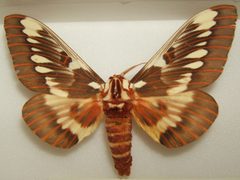
Citheronia splendens sinaloensis is a of giant silkmoth in the Saturniidae, described by Hoffmann in 1942. It belongs to a whose larvae are commonly known as "hickory horned devils" due to their large size and prominent horn-like . The subspecies epithet "sinaloensis" indicates a type locality in Sinaloa, Mexico, distinguishing it from the nominate subspecies C. splendens splendens found in Arizona. Like other members of the genus, it undergoes complete with dramatically different appearances between early and late larval instars.
Pronunciation
How to pronounce Citheronia splendens sinaloensis: //ˌsɪθɛˈroʊniə ˈsplɛndɛnz ˌsɪnəloʊˈɛnsɪs//
These audio files are automatically generated. While they are not always 100% accurate, they are a good starting point.
Identification
The Citheronia splendens sinaloensis can be distinguished from the nominate subspecies C. s. splendens by its Mexican (Sinaloa) versus Arizonan distribution. Within the , -level identification of larvae is challenging due to convergent ; early instars across multiple Citheronia species share the distinctive clubbed spines and similar coloration. Definitive identification typically requires rearing to adulthood or molecular analysis. The subspecies may be distinguished from C. laocoon and C. brissotii (Brazilian species) and C. regalis (eastern North American species) by geographic range and subtle differences in wing patterns, though these characters require expert evaluation.
Images
Distribution
Known from Sinaloa, Mexico (type locality) and potentially adjacent regions of northwestern Mexico. GBIF records indicate presence in Middle America and North America, though specific locality data beyond the type series are sparse. The represents the southern, Mexican component of the C. splendens , with the nominate subspecies occurring in Arizona, USA.
Life Cycle
Complete with four life stages: , larva, pupa, . Early instar larvae (L1–L2) bear distinctive clubbed spines that are replaced by more conventional curved horns in later instars. The dramatic morphological difference between early and late instars is characteristic of the and has been documented in related . Larvae feed on plant foliage before descending to pupate in soil or leaf litter. Adults are non-feeding with mouthparts.
Similar Taxa
- Citheronia splendens splendensNominate occurring in Arizona, USA; distinguished by geographic separation and potentially subtle differences in wing pattern and genitalia.
- Citheronia lobesisCentral American with early instar larvae remarkably similar in color pattern to C. s. sinaloensis; distinguished by geographic range and .
- Citheronia regalisEastern North American (hickory horned devil/regal ) with similar larval but different distribution and plant preferences.
- Citheronia laocoonCommon Brazilian with nearly identical early instar larvae; distinguished by South American versus Mexican distribution.
More Details
Taxonomic history
Described by Carlos Hoffmann in 1942 based on material from Sinaloa, Mexico. The represents part of a whose members show strong larval morphological convergence, complicating identification without geographic or molecular data.
Larval spine morphology
The "fly swatter" clubbed spines of early instars are unique among North American Saturniidae and represent a derived character state within the . The functional significance of this —whether defensive, mimetic, or structural—remains unexplored.
Sources and further reading
- BugGuide
- GBIF taxonomy match
- iNaturalist taxon
- NCBI Taxonomy
- Catalogue of Life
- Silkmoth Season, Part 2: A royal welcome – Royal Walnut Moth, Citheronia regalis — Bug of the Week
- Brazil Bugs #16 – Royal Moth Larva | Beetles In The Bush
- Super Crop Challenge | Beetles In The Bush | Page 3
- Lepidoptera | Beetles In The Bush | Page 8
- Brazil | Beetles In The Bush
- Devils and hummingbirds - Hickory horned devil, Citheronia regalis and hummingbird clearwing moth, Hemaris thysbe — Bug of the Week