
Anisota virginiensis pellucida
A of the pink-striped oakworm moth, distinguished by more transparent or translucent wing areas in . The caterpillars feed on oak foliage and develop through several instars before pupating in soil. Adults emerge in summer and are active during daylight hours.
Pronunciation
How to pronounce Anisota virginiensis pellucida: //ˌænɪˈsoʊtə vɜːˌdʒɪˈniːənˌsɪs pɛˈluːsɪdə//
These audio files are automatically generated. While they are not always 100% accurate, they are a good starting point.
Identification
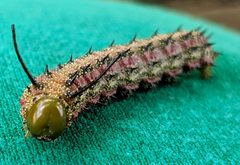
differ from the nominate Anisota virginiensis virginiensis by possessing more extensive transparent or hyaline areas on the wings, particularly the hindwings. The pink to rose-colored stripes on the and are retained. Caterpillars resemble other Anisota with black bodies, yellowish to orange stripes, and paired fleshy horns behind the .
Images
Habitat
Associated with oak-dominated forests and woodlands where trees occur.
Distribution
The subspecific epithet "pellucida" suggests distribution in areas where transparent-winged forms occur; precise range boundaries relative to the nominate are not well documented in available sources.
Seasonality
active in summer; caterpillars present during growing season when oak foliage is available.
Diet
Caterpillars feed on oak leaves (Quercus spp.), particularly in the red oak group.
Host Associations
- Quercus - larval oak
Life Cycle
Complete with four larval instars. laid on oak leaves. Caterpillars feed gregariously early in development, later dispersing. Mature larvae drop to ground and burrow into soil to pupate. emerge the following season.
Behavior
Caterpillars feed primarily at night. When disturbed, they may drop from foliage on silk threads. Mature larvae descend tree trunks to seek sites in soil. are and do not feed.
Ecological Role
Defoliator of oaks; periodic can cause significant leaf loss. Serves as prey for birds, , and other natural enemies.
Human Relevance
Can become a pest of ornamental oaks during years. Caterpillars may be conspicuous when descending trees to pupate, sometimes crossing sidewalks and trails in large numbers.
Similar Taxa
- Anisota virginiensis virginiensisNominate with less transparent wing areas; otherwise similar in and appearance
- Anisota senatoriaOrangestriped oakworm with orange rather than pink stripes; caterpillars have more prominent orange striping
- Anisota stigmaSpiny with different color pattern and more southerly distribution
Sources and further reading
- BugGuide
- Clearwinged Grasshopper
- Grasshoppers of Colorado
- Bruner Slantfaced Grasshopper
- Megalopygidae | Beetles In The Bush
- Outrage for oaks – Orangestriped Oakworm, Anisota senatoria — Bug of the Week
- Trails of despair for wild silk moth caterpillars: Orangestriped Oakworm, Anisota senatoria, and Greenstriped mapleworm, Dryocampa rubicunda — Bug of the Week