
Anisota oslari
Rothschild, 1907
Oslar's oakworm moth
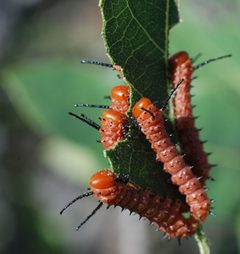
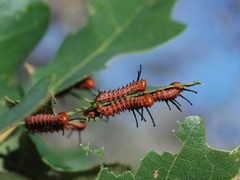
Anisota oslari is a saturniid native to the southwestern United States and Mexico. are day-flying and active during summer months, with a single . The larvae are specialized feeders on oak (Quercus), with documented including sandpaper oak (Q. pungens), Mexican blue oak (Q. oblongifolia), and shrub live oak (Q. turbinella). Larvae exhibit gregarious when young, becoming solitary as they mature. The species overwinters as pupae in shallow underground chambers.
Pronunciation
How to pronounce Anisota oslari: /ˌænɪˈsoʊtə ˈɒzlæraɪ/
These audio files are automatically generated. While they are not always 100% accurate, they are a good starting point.
Identification
Distinguished from other Anisota by geographic distribution in the southwestern U.S. and Mexico. are day-fliers, unlike many Saturniidae. Larval identification to species level requires plant association and geographic context, as Anisota larvae are morphologically similar. Distinguished from A. senatoria (orangestriped ) and A. virginiensis (pink-striped oakworm) by range—those species occur primarily in eastern and central North America.
Images
Habitat
Associated with oak woodlands and scrublands in arid and semi-arid regions. Documented from sandpaper oak (Quercus pungens) in Trans-Pecos, Texas. Occurs in montane and foothill environments from southwestern Colorado through New Mexico, Arizona, and western Texas.
Distribution
Southwestern Colorado south through New Mexico and southeastern Arizona to far western Texas and Mexico. Specifically documented from Trans-Pecos, Texas.
Seasonality
active July to August. One per year. Overwinters as pupae in soil.
Diet
Larvae feed exclusively on Quercus (oak) , including Quercus pungens (sandpaper oak), Quercus oblongifolia (Mexican blue oak), and Quercus turbinella (shrub live oak). do not feed.
Host Associations
- Quercus pungens - larval sandpaper oak, first recorded in Trans-Pecos, Texas
- Quercus oblongifolia - larval Mexican blue oak
- Quercus turbinella - larval shrub live oak
Life Cycle
Complete with one annually. laid on underside of oak leaves. Larvae hatch and feed gregariously when young, becoming solitary as they grow. Fully grown larvae descend from trees, burrow into soil to form shallow underground chambers, and pupate. emerge the following summer.
Behavior
are (day-flying), an unusual trait among Saturniidae. Young larvae feed gregariously in groups; older larvae are solitary. Larvae drop from trees to pupate in soil.
Ecological Role
Larval defoliator of oaks. Contributes to nutrient cycling through leaf consumption and production. Serves as prey for and other natural enemies. Provides food source for insectivorous birds and other during larval stage.
Human Relevance
Occasional localized defoliator of landscape oaks in urban and suburban areas of its range. possible but typically short-lived. Management rarely necessary; natural enemies usually control . Mechanical removal of larval clusters possible for high-value trees.
Similar Taxa
- Anisota senatoriaSimilar larval and , but occurs in eastern and central North America; distinguished by geographic range and oak
- Anisota virginiensisSimilar larval with pink stripes, but eastern distribution; distinguished by range and coloration
- Anisota stigmaSpiny with overlapping southwestern range; distinguished by larval spination and specific associations
More Details
Conservation note
First recorded from Trans-Pecos, Texas in 2018, expanding known distribution and documenting sandpaper oak as a . This record highlights ongoing range documentation for this relatively understudied .
Sources and further reading
- BugGuide
- Wikipedia
- GBIF taxonomy match
- iNaturalist taxon
- Catalogue of Life
- Outrage for oaks – Orangestriped Oakworm, Anisota senatoria — Bug of the Week
- Trails of despair for wild silk moth caterpillars: Orangestriped Oakworm, Anisota senatoria, and Greenstriped mapleworm, Dryocampa rubicunda — Bug of the Week
- Much Ado About Nothing? End-of-Summer Defoliation Heats Up
- Megalopygidae | Beetles In The Bush
- ID Challenge #11 | Beetles In The Bush
- Archive — Bug of the Week
- First Record of Anisota oslari from Trans-Pecos, Texas Using Sandpaper Oak as a Host