
Prodoxus decipiens
Riley, 1880
Bogus Yucca Moth
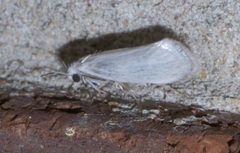
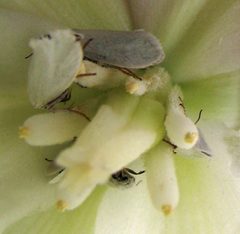
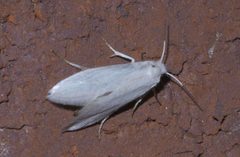
Prodoxus decipiens is a bogus yucca moth ( Prodoxidae) that specializes on Yucca plants. Unlike mutualistic yucca moths, this does not pollinate its host but instead lays in flowering stalks where larvae develop internally. Host use is constrained by both ecological availability and intrinsic host plant characteristics; larvae successfully complete development only on specific Yucca species. The species exhibits strong host specialization, with typically associated with particular Yucca hosts such as Yucca filamentosa.
Pronunciation
How to pronounce Prodoxus decipiens: //proˈdɔksʊs dɛˈkɪpiɛns//
These audio files are automatically generated. While they are not always 100% accurate, they are a good starting point.
Images
Habitat
Associated with Yucca plants in open, dry including prairies, savannas, and scrublands where occur.
Distribution
Eastern North America, with records tied to the range of its Yucca plants.
Seasonality
activity coincides with Yucca flowering periods, typically late spring to early summer; larval development occurs within flowering stalks.
Diet
Larvae feed internally on tissues of Yucca flowering stalks. do not feed; they rely on larval reserves.
Host Associations
- Yucca filamentosa - primary Primary in parts of range; larvae complete development successfully.
- Yucca - -level -level specialization with -specific associations; not all Yucca support larval development.
Life Cycle
are laid in Yucca flowering stalks. Larvae feed internally on stalk tissues, developing to . occurs within the stalk; emerge during subsequent flowering periods.
Behavior
Females are attracted to flowers of multiple Yucca and attempt oviposition broadly, but larval survival is -specific. Males use to locate females.
Ecological Role
Herbivore of Yucca; non-pollinating relative of mutualistic yucca moths. Contributes to top-down pressure on Yucca reproductive structures.
Similar Taxa
- Prodoxus quinquepunctellusSister with overlapping Yucca range; distinguished by host associations and geographic distribution.
- Tegeticula yuccasellaMutualistic yucca moth that pollinates Yucca and has similar size and appearance; distinguished by pollination and larval feeding in seeds rather than stalks.