
Tegeticula yuccasella
(Riley, 1873)
yucca moth, Eastern Yucca Moth
Tegeticula yuccasella is a small in the Prodoxidae, first described by Charles Valentine Riley in 1872. It is the nominate of the T. yuccasella , a group of obligate of yucca plants (Yucca spp.). The moth engages in active pollination unique among Lepidoptera: females collect pollen with specialized tentacle-like mouthparts and deliberately deposit it on yucca stigmas to ensure fruit set before laying . Larvae feed exclusively on developing yucca seeds. Recent systematic revision has split this formerly broadly-defined species into multiple distinct species, with T. yuccasella sensu stricto associated primarily with eastern North American yucca .
Pronunciation
How to pronounce Tegeticula yuccasella: /tɛɡɛˈtʃuːlɪ.kə jʌkˌkæˈsɛlə/
These audio files are automatically generated. While they are not always 100% accurate, they are a good starting point.
Identification
Identification to within the T. yuccasella complex requires examination of genitalia, molecular markers, and association. T. yuccasella sensu stricto is associated with eastern North American yucca hosts including Yucca filamentosa. Distinguishing from similar : T. cassandra, T. elatella, and other newly described species in the complex differ in host associations, geographic distribution, and subtle morphological characters. Non-pollinating 'cheater' species in the (T. intermedia, T. corruptrix) can be distinguished by oviposition into fruits rather than flowers and lack of active pollination.
Images
Appearance
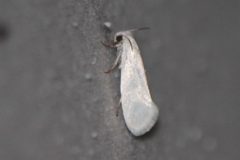
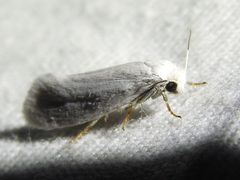
Small with wingspan of 18–27 mm. Females possess distinctive tentacle-like maxillary palps used for collecting and manipulating pollen, a unique among moths. General coloration is non-descript gray. Detailed morphological characters distinguishing T. yuccasella from other members of the require expert examination.
Habitat
Associated with yucca plants in open, well-drained . In the eastern United States, found in sandy coastal plains and other areas where Yucca filamentosa occurs. Plains in Colorado support higher abundance than marginal foothill sites at higher elevation.
Distribution
North America from Texas to southern Canada, with primary association in eastern North America. Alberta, Canada. Specific range boundaries within the T. yuccasella complex are currently being refined due to recent taxonomic revision splitting the former broadly-defined .
Seasonality
active during spring yucca bloom period. Larval development occurs within developing yucca fruits.
Diet
Larvae feed exclusively on developing seeds of Yucca . Documented include Yucca filamentosa, Yucca smalliana, Yucca flaccida, Yucca glauca, Yucca arkansana, Yucca constricta, Yucca rupicola, Yucca pallida, Yucca reverchoni, and Yucca aloifolia. do not feed.
Host Associations
- Yucca filamentosa - obligate mutualism; larval Primary eastern ; classic mutualism studied extensively
- Yucca smalliana - larval
- Yucca flaccida - larval
- Yucca glauca - larval Studied in Colorado ; abundance higher in plains than foothills
- Yucca arkansana - larval
- Yucca constricta - larval
- Yucca rupicola - larval
- Yucca pallida - larval
- Yucca reverchoni - larval
- Yucca aloifolia - larval
Life Cycle
laid in yucca ovary, typically near fertilized ovules. Larvae develop within fruit, feeding on seeds. occurs in soil. emerge to seek yucca flowers for and pollination. Some larvae die before completing development; fruits occasionally lack evidence of .
Behavior
Females exhibit active pollination unique among : they scrape pollen from anthers into a ball using tentacle-like maxillary palps, carry it under the chin to another flower, and deliberately deposit it on the stigma before ovipositing. This ensures fruit development that provides food for larvae. Self-pollination within plants has been documented as frequent (mean 55% of pollen transfers), though genetic outcrossing rates remain high (94%). Females may periodically overload fruits with . At Colorado foothill sites, low moth abundance correlates with reduced fruit set.
Ecological Role
Obligate of multiple Yucca ; the mutualism represents a classic example of coevolved plant-pollinator interaction. The relationship has been described as facultative rather than strictly obligate in some contexts, as alternative pollinators (e.g., Pseudocalliope sp. fly) may contribute to yucca at sites with low abundance, and autogamy occurs infrequently.
Human Relevance
Subject of extensive scientific research on and mutualism since first described in 1872. The yucca-yucca interaction is frequently cited as a textbook example of obligate mutualism and coevolutionary dynamics, though recent research has complicated this narrative. No significant economic or agricultural impact.
Similar Taxa
- Tegeticula antitheticaExclusive of eastern Joshua tree (Yucca jaegeriana); similar size and appearance but distinct association and genetically differentiated; 6 mm length vs. 9 mm for T. synthetica
- Tegeticula synthetica of western Joshua tree (Yucca brevifolia); longer ovipositor and larger size (9 mm) than T. antithetica; differs in and pistil maneuvering space due to flower
- Tegeticula cassandra, T. elatella, T. altiplanella, T. baccatella, T. carnerosanella, T. maderae, T. mojavella, T. rostratella, T. superficiella, T. treculeanellaNewly described from 1999 revision of T. yuccasella complex; differ in associations, geographic distribution, and subtle morphological characters
- Tegeticula intermedia, Tegeticula corruptrixNon-pollinating 'cheater' that oviposit into fruits rather than flowers; lack active pollination ; originally misidentified or synonymized with T. yuccasella
Misconceptions
The yucca-yucca mutualism has been historically characterized as strictly obligate, with moths as sole . However, research on Yucca glauca in Colorado demonstrates that: (1) self-pollination is common and may be detrimental to larval survival, (2) alternative pollinators (flies) may contribute to , (3) autogamy occurs infrequently, and (4) the mutualism may be better described as facultative in some contexts. Additionally, T. yuccasella was formerly considered a single pollinating most yuccas; it is now recognized as a complex of multiple -specific species.
More Details
Taxonomic revision
The 1999 systematic revision by Pellmyr recognized that T. yuccasella as historically defined comprised multiple biological . Ten new species were described from north of Mexico, plus two non-pollinating cheater species. The nominotypical T. yuccasella was redescribed with more restricted and geographic range.
Pollination paradox
Despite active pollination evolved to ensure outcrossing, fluorescent dye tracking studies show that 55% of pollen transfers occur within plants (self-pollination). However, genetic estimates indicate 94% outcrossing in resulting seedlings, suggesting strong post-pollination selection against selfed progeny or abortion of self-pollinated fruits.
Research significance
This mutualism has been studied for over 130 years as a model system for understanding . Recent research focuses on whether reciprocal drives speciation and improved , with Joshua tree systems providing particularly fine-tuned examples of morphological matching between ovipositor length and floral style length.
Sources and further reading
- BugGuide
- Wikipedia
- GBIF taxonomy match
- iNaturalist taxon
- NCBI Taxonomy
- Catalogue of Life
- Tegeticula antithetica Archives - Entomology Today
- Unique Relationship Between Joshua Tree and Moth Documented for First Time
- Systematic revision of the yucca moths in the Tegeticula yuccasella complex (Lepidoptera: Prodoxidae) north of Mexico
- The Yucca Plant, Yucca filamentosa, and the Yucca Moth, Tegeticula (Pronuba) yuccasella Riley: An Ecologico-Behavior Study
- Pollen dispersal in Yucca filamentosa (Agavaceae): the paradox of self‐pollination behavior by Tegeticula yuccasella (Prodoxidae)
- Reproductive consequences of interactions between Y ucca glauca (Agavaceae) and T egeticula yuccasella (Lepidoptera) in Colorado