
Paraclemensia acerifoliella
(Fitch, 1854)
Maple Leafcutter Moth
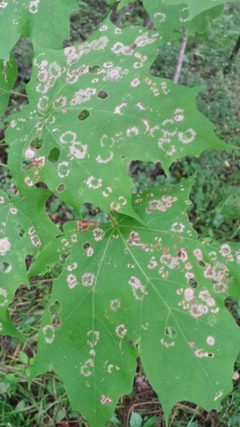
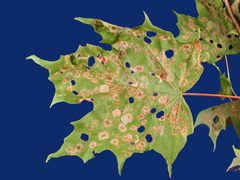
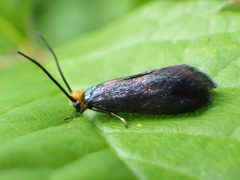
Paraclemensia acerifoliella is a small in the Incurvariidae, known as the maple leafcutter moth. It is native to North America with a range spanning southeastern Canada, the northeastern United States, and south along the Appalachians to western North Carolina. The has one per year, with active in spring. Larvae are leaf miners that later construct portable cases from cut leaf pieces.
Pronunciation
How to pronounce Paraclemensia acerifoliella: /ˌpærəklɛˈmɛnsiə æsərɪfoʊliˈɛlə/
These audio files are automatically generated. While they are not always 100% accurate, they are a good starting point.
Identification
Small size (9–12 mm wingspan) and spring period (April–June) help distinguish this . The leafcutter —larvae mining leaves and later carrying portable cases made from cut leaf discs—is diagnostic for the Incurvariidae. Distinguished from other Paraclemensia species by association and geographic range; western on Amelanchier alnifolia versus eastern populations on Acer species.
Images
Habitat
Associated with deciduous forest containing trees. In sugar maple stands, larvae are most abundant on leaves near the base of the crown and close to the tree trunk (0.6–1.2 m from bole), with decreasing toward the crown periphery.
Distribution
Southeastern Canada (Ontario, Quebec, Manitoba, Saskatchewan, Alberta), northeastern United States, and south along the Appalachian Mountains to western North Carolina and possibly northwestern Georgia. Western Canadian represent a range expansion.
Seasonality
on wing from April to June. One per year.
Diet
Larvae feed on leaves of Acer (maple) , particularly sugar maple (Acer saccharum). Also recorded on Fagus, Quercus, Betula, huckleberry species, and in western Canada on saskatoon (Amelanchier alnifolia).
Host Associations
- Acer saccharum - primary sugar maple; highest mine densities on leaves near crown base and trunk
- Amelanchier alnifolia - saskatoon; newly discovered in western Canada representing derived capability
- Fagus - occasional
- Quercus - occasional
- Betula - occasional
Life Cycle
One per year. laid on leaves. Larvae initially mine leaves, then transition to case-bearing stage 1–2 months later, constructing portable cases from circular leaf cuts. Larval cases and foliar damage become more prevalent from the trunk outward to 3 m as development progresses. occurs within the case.
Behavior
Larvae are leaf miners in early instars, then become case-bearers that construct portable cases from cut leaf discs which they carry while feeding. Case-bearing larvae and associated leaf damage increase in from the tree trunk outward to 3 m as the season progresses.
Ecological Role
Herbivore on deciduous trees; leaf mining and cutting activity causes foliar damage. distribution within tree crowns is spatially structured, with highest densities near the crown base and trunk.
Human Relevance
Minor pest of sugar maple and other hardwood ; leaf damage from mining and cutting activity. Subject of ecological research on plant relationships and .
Similar Taxa
- Other IncurvariidaeSimilar case-bearing larval ; distinguished by specificity, geographic range, and size/ period
- Other leaf-mining LepidopteraSimilar leaf mining damage; distinguished by case-bearing in later instars, which is characteristic of Incurvariidae
More Details
Biogeographical significance
The discovery of western Canadian on Amelanchier alnifolia represents both a range expansion and a shift. Maple feeding is hypothesized to be the ancestral condition in the Paraclemensia, while Rosaceae feeding (including Amelanchier) is hypothesized to be a derived capability of the P. acerifoliella group.
Population distribution pattern
In sugar maple crowns, mine is highest at 0.6–1.2 m from the trunk and decreases at 2.4 m and beyond. No significant difference exists among cardinal directions. This spatial pattern may reflect oviposition or larval survival factors.
Sources and further reading
- BugGuide
- Wikipedia
- GBIF taxonomy match
- iNaturalist taxon
- NCBI Taxonomy
- Catalogue of Life
- Bionomics of the Maple Leaf Cutter, Paraclemensia acerifoliella (Fitch), (Lepidoptera: Incurvariidae)
- POPULATION DISTRIBUTION OF THE MAPLE LEAFCUTTER, PARACLEMENSIA ACERIFOLIELLA (LEPIDOPTERA: INCURVARIIDAE), IN SUGAR MAPLE TREES
- Paraclemensia acerifoliella (Lepidoptera: Incurvariidae) in western Canada: a newly discovered host, an expanded range, and biogeographical considerations