
Paraclemensia
Busck, 1904
maple leafcutter moths
Species Guides
1- Paraclemensia acerifoliella(Maple Leafcutter Moth)
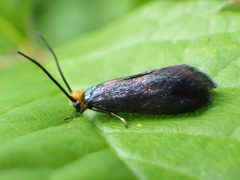
Paraclemensia is a of primitive in the Incurvariidae. Larvae are leaf miners that later construct portable cases from cut leaf pieces, earning the 'leafcutter' for at least one . The genus includes species associated with maple (Acer) and, in at least one documented case, with Rosaceae . Most detailed biological information comes from studies of P. acerifoliella, the maple leafcutter.
Pronunciation
How to pronounce Paraclemensia: //pɛɹəˈklɛmɛnsiə//
These audio files are automatically generated. While they are not always 100% accurate, they are a good starting point.
Images
Habitat
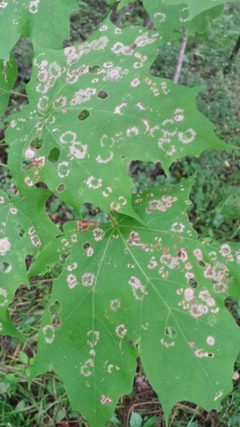
Associated with deciduous trees and shrubs; P. acerifoliella has been documented in sugar maple crowns, with larvae concentrated in inner crown zones near the trunk base. Western have been found on saskatoon (Amelanchier alnifolia) in shrubby .
Distribution
North America; documented from eastern Canada (Ontario, Quebec) and western Canada, with records from Vermont and the United States. Distribution varies by : P. acerifoliella occurs in both eastern and western Canada, while other species have more restricted ranges (e.g., P. caerulea, P. cyanea, P. viridis described from Japan or other regions).
Diet
Larvae feed on leaf tissue of plants. P. acerifoliella feeds on sugar maple (Acer saccharum) and has been documented on saskatoon (Amelanchier alnifolia); maple feeding is hypothesized to be ancestral for the , with Rosaceae feeding a derived trait in the P. acerifoliella group.
Host Associations
- Acer saccharum - larval sugar maple; primary for P. acerifoliella in eastern Canada
- Amelanchier alnifolia - larval saskatoon; newly documented for P. acerifoliella in western Canada
- Acer - larval maple ; ancestral association hypothesized for genus
Life Cycle
Larvae begin as leaf miners, creating mines in foliage. One to two months after the leaf-mining stage, larvae transition to case-bearing , constructing portable cases from cut leaf pieces. Specific details on , pupal, and stages are not documented in available sources.
Behavior
Larvae exhibit two distinct feeding phases: initial leaf-mining followed by case-bearing using cut leaf sections. P. acerifoliella larvae show spatially structured distribution within tree crowns, with higher densities in inner crown zones close to the trunk.
Ecological Role
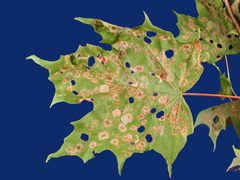
Leaf-mining herbivore causing foliar damage to trees and shrubs. densities can be locally concentrated, with measurable impact on leaf tissue in preferred crown zones.
Similar Taxa
- Incurvariaalso in Incurvariidae with leaf-mining and case-bearing larvae; Paraclemensia distinguished by genitalia and specific associations
- Phylloporiarelated incurvariid ; Paraclemensia generally associated with Acer and Rosaceae rather than other plant
More Details
Taxonomic history
The was established by Busck in 1904. -level includes several East Asian species (P. caerulea, P. cyanea, P. viridis, P. monospina, P. oligospina) described by Nielsen in 1982, suggesting the genus has broader geographic distribution than the well-studied North American P. acerifoliella.
Biogeographic hypotheses
Comparative studies suggest maple feeding represents the ancestral condition in Paraclemensia, with the ability to feed on Rosaceae (as documented in western P. acerifoliella ) representing a derived ecological trait within the P. acerifoliella group.
Sources and further reading
- BugGuide
- Wikipedia
- GBIF taxonomy match
- iNaturalist taxon
- NCBI Taxonomy
- Catalogue of Life
- Bionomics of the Maple Leaf Cutter, Paraclemensia acerifoliella (Fitch), (Lepidoptera: Incurvariidae)
- POPULATION DISTRIBUTION OF THE MAPLE LEAFCUTTER, PARACLEMENSIA ACERIFOLIELLA (LEPIDOPTERA: INCURVARIIDAE), IN SUGAR MAPLE TREES
- Paraclemensia acerifoliella (Lepidoptera: Incurvariidae) in western Canada: a newly discovered host, an expanded range, and biogeographical considerations