
Phylloporia
Murrill 1904
Species Guides
1- Phylloporia bistrigella(Striped Bright)
of polypore fungi in Hymenochaetaceae, order Hymenochaetales. produce to basidiomata with resupinate to pileate-stipitate growth forms and characteristic duplex context. Hyphal system monomitic to dimitic. Basidiospores globose to cylindrical, thick-walled, yellowish to pale brown in KOH. Approximately 72 species described worldwide, predominantly distributed in tropical regions.
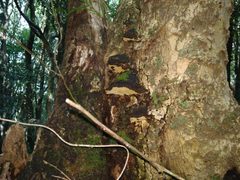
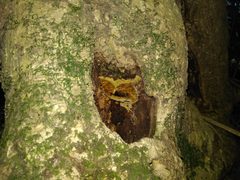
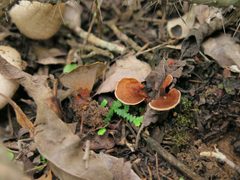
Pronunciation
How to pronounce Phylloporia: /ˌfɪloʊˈpɔːriə/
These audio files are automatically generated. While they are not always 100% accurate, they are a good starting point.
Images
Habitat
Tropical , including tropical dry forests, cloud forests at medium elevations (1200–1400 m), and Atlantic Forest remnants. Some occur in small urban protected areas. Substrates include angiosperm stumps, living lianas, living stems of Doliocarpus schottianus, and soil under angiosperm trees in dense dry forests.
Distribution
Widely distributed in the tropics. Documented from West Africa (Benin), Central Africa (Gabon, Cameroon), East Africa, Mexico (Jalisco), Ecuador (Mindo Valley, San Carlos, Guamani, Wild Sumaco Lodge), southern Brazil, and China (Shandong Province, Hainan Province). Fifteen known from tropical Africa; eight recorded in Mexico.
Diet
Wood-decay fungi. Predominantly parasitic on woody plant ; some saprotrophic on dead wood. P. crystallina causes white rot on angiosperm stumps; P. sumacoensis parasitic on living lianas; P. minuta parasitic on living stems of Doliocarpus schottianus. Trophic status of some species (e.g., P. mutabilis) requires further study.
Host Associations
- Lonicera japonica - parasitic of P. lonicerae, widely used medicinal
- Fontanesia fortunei - parasitic of P. fontanesiae, rarely used medicinally
- Pyrus - parasitic of P. pulla, potentially used medicinally
- Doliocarpus schottianus - parasitic of P. minuta, living stems
- Angiosperm stump - saprotrophicsubstrate of P. crystallina, freshly dead wood
- Living liana - parasiticsubstrate of P. sumacoensis
- Angiosperm trees - unknownP. mutabilis grows on soil under trees in dense dry forest, trophic status unconfirmed
Life Cycle
to basidiomata. via basidiospores produced on basidia with four sterigmata.
Behavior
Stipitate growth form (stalked basidiomata) observed in multiple . Some species exhibit imbricate (overlapping, shingle-like) basidiomata. Growth habit ranges from resupinate (crust-like, flat on substrate) to pileate- (cap without stalk) to pileate-stipitate (cap with central stalk). Speciation driven by and .
Ecological Role
Wood-decay fungus causing white rot. Decomposer of angiosperm wood in tropical . Some function as on living woody plants, including lianas and tree stems. Contributes to nutrient cycling in tropical forests.
Human Relevance
Basidiocarps used as source of natural medicine in China, mainly in Shandong Province. P. lonicerae on Lonicera japonica is the most widely used medicinal . P. fontanesiae and P. pulla have limited or potential medicinal use. Species studied for antitumor activity (P. crataegi, P. fontanesiae). Extraction optimization investigated for P. ribis to enhance biological activity. Taxonomic clarification essential for medicinal studies and industry development.
Sources and further reading
- BugGuide
- Wikipedia
- iNaturalist taxon
- NCBI Taxonomy
- Catalogue of Life
- Two new species of Phylloporia (Hymenochaetales) from the Neotropics
- New species and a new record of Phylloporia from Benin
- Two new stipitate species of Phylloporia (Basidiomycota, Hymenochaetaceae) from Chamela Biology Station, U.N.A.M. in Jalisco, Mexico
- Phylloporia minuta sp. nov. (Basidiomycota, Hymenochaetales): a remarkable species discovered in a small protected urban area of Atlantic Forest
- Phylloporia mutabilis sp. nov. from Benin, West Africa
- Species clarification of the medicinal wood-inhabiting fungus Phylloporia (Hymenochaetales, Basidiomycota) in China
- Dentipellicula hainanensis (Hericiaceae, Agaricomycetes) and Phylloporia rigida (Hymenochaetaceae, Agaricomycetes), two new species of wood-inhabiting fungi from Hainan Province, South China.
- Artificial intelligence-assisted optimization of extraction enhances the biological activity of Phylloporia ribis.
- Comparative Multi-Omics Analysis and Antitumor Activity of Phylloporia crataegi and Phylloporia fontanesiae.