
Heliozela aesella
Chambers, 1877
Heliozela aesella is a small in the Heliozelidae, first described by Chambers in 1877. The occurs in northeastern and midwestern North America, where larvae develop as leaf miners in grape vines. are active for a brief period in spring, with a single per year. The species is notable for its distinctive larval of cutting out a portable case from the leaf mine before dropping to the ground to pupate.
Pronunciation
How to pronounce Heliozela aesella: //hɛliˈoʊzɛlə iːˈsɛlə//
These audio files are automatically generated. While they are not always 100% accurate, they are a good starting point.
Identification
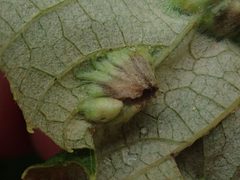
are most readily identified by period (late April to early May) and association with grape . Larvae can be identified by their presence in grape leaf mines in late May, with full-grown larvae cutting a distinctive oval case from the leaf tissue. The combination of plant (Vitis), geographic range, and larval case-building distinguishes this from other Heliozela species.
Images
Appearance
Small with narrow wings typical of the Heliozelidae. are likely nondescript with reduced wing venation characteristic of the superfamily Adeloidea. Larvae are leaf miners that create blotchy mines in grape leaves.
Habitat
Associated with grape-growing regions, including wild and cultivated Vitis . Found in deciduous woodlands, forest edges, vineyards, and riparian areas where grapes occur.
Distribution
Eastern and midwestern North America: United States (Illinois, Iowa, Kentucky, Massachusetts, Minnesota, New York, Ohio, Wisconsin, Vermont) and Canada (Quebec).
Seasonality
active late April to early May. One per year. Larvae present in late May. occurs in soil within larval cases, with adults emerging the following spring after .
Diet
Larvae feed on Vitis (grapes). Feeding occurs as leaf miners within leaf tissue.
Host Associations
- Vitis - larval plant
Life Cycle
stage not described in sources. Larvae develop as leaf miners in grape leaves during late May. Full-grown larvae cut an oval case from the mined leaf and drop to the ground. occurs within this case after . emerge the following spring.
Behavior
Larvae exhibit a distinctive case-building : full-grown individuals cut out a portable case from the leaf mine, carrying it to the ground where occurs. This behavior is characteristic of the Heliozelidae. are or , with limited period in spring.
Ecological Role
on native and cultivated grapes. Role in natural not well documented; in vineyards, larvae may cause minor aesthetic damage to leaves but are not considered a significant pest.
Human Relevance
Minor potential pest in vineyards due to leaf mining activity, though damage is generally insignificant. More commonly encountered by lepidopterists and naturalists during spring surveys.
Similar Taxa
- Other Heliozela speciesSeveral Heliozela occur in North America; H. aesella is distinguished by association with Vitis and specific geographic range. H. sericiella and related species typically use different host plants.
- Other grape-feeding LepidopteraGrape leaf folder (Desmia funeralis) and grapeleaf skeletonizer (Harrisina americana) cause more conspicuous damage and do not form the distinctive oval larval cases characteristic of Heliozela.
More Details
Larval case construction
The of cutting a portable case from the leaf mine is a -level synapomorphy for Heliozelidae. In H. aesella, this case is oval and constructed from the upper and lower of the mined leaf area, allowing the larva to descend to the soil surface protected from and desiccation.