
Vespula infernalis
(de Saussure, 1854) Kimsey & Carpenter, 2012
cuckoo yellowjacket, American cuckoo yellowjacket
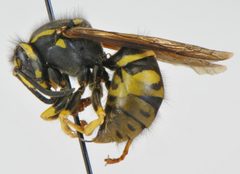
Vespula infernalis is an obligate social () that invades and usurps colonies of other yellowjacket , primarily Vespula acadica in North America. Unlike most parasitic , it exhibits intensely aggressive during colony takeover, using specialized morphological adaptations including a large, heavily curved stinger to subdue . The species lacks a worker and cannot build nests or rear its own young, instead forcing host workers to feed and care for its through dominance behaviors including mauling and forced .
Pronunciation
How to pronounce Vespula infernalis: /vɛsˈpuːla ɪnfɛrˈnaːlɪs/
These audio files are automatically generated. While they are not always 100% accurate, they are a good starting point.
Identification
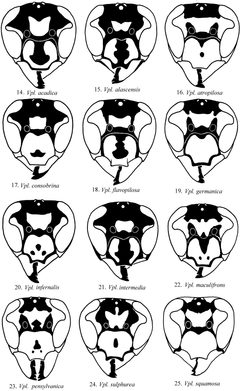
Distinguished from by irregular margins and narrow yellow marks on the scape. Females have a wider with fewer lateral black bands and black dots; males have a longer abdomen with thick lateral black bands. Larger width than its V. acadica. The most distinctive feature is the large, heavily curved stinger—an for puncturing intersegmental of defending host . Near the edge of , possesses a fourth marginal tooth (host V. acadica has three).
Images
Habitat
Associated with colonies in forest and temperate woodland environments. Found in nests of Vespula acadica, which typically nest in subterranean cavities, rotting stumps, or other enclosed spaces.
Distribution
Nearctic region, specifically the region of North America. Occurs throughout all Canadian provinces and territories, and in the United States in Alaska, New Jersey, Michigan, Wisconsin, North Dakota, New Mexico, Arizona, and California. considered stable throughout range.
Seasonality
Very short periods: June to mid-July, and August to mid-September. Females hibernate longer than queens, emerging after host colonies are established.
Diet
Obtains nourishment exclusively through forced with ; rarely solicits larvae for food. Does not forage independently.
Host Associations
- Vespula acadica - primary Obligate of colonies; usurps established nests and forces to rear
Life Cycle
Obligate social with no . Females emerge from hibernation after queens, invade established host colonies during -reared worker stage when nests are most vulnerable. After killing or driving away the host queen, the parasite takes over nest and forces host workers to feed her and rear her . Oviposition occurs during and after the mauling period, with laid in new combs, on cell walls, exterior of comb, between cells, or along caps. Brood cared for entirely by host workers. New queens and males produced in autumn; queens overwinter to repeat cycle.
Behavior
Exhibits exceptionally aggressive invasion compared to other parasitic . During usurpation, uses and curved stinger to attack , causing injuries including broken and leg damage. Post-invasion, patrols and inspects , engages in mauling (grabbing with legs and chewing dorsums) and chasing to assert dominance. Solicits and forces throughout colony occupation; intensity declines in later stages. Does not forage, build cells, feed larvae, or assist in or nest defense. Releases substances from during gastral dragging that suppress host worker .
Ecological Role
Social that reduces colony productivity; parasitized V. acadica nests are smaller than unparasitized nests. May exert top-down influence on host in .
Similar Taxa
- Vespula austriacaSister nearly identical in appearance and ; Old World counterpart. Nearctic was previously considered , appearing in pre-2012 literature as V. austriaca.
- Vespula acadicaPrimary ; V. infernalis distinguished by larger width, more curved stinger, fourth mandibular tooth, and scape markings.
Sources and further reading
- BugGuide
- Wikipedia
- GBIF taxonomy match
- iNaturalist taxon
- The Wonderful World of Wasps | Bug Squad
- Surprise visit by a queen: German yellowjacket, Vespula germanica — Bug of the Week
- Fierce Southern Stingers in the DMV: Southern Yellowjackets, Vespula squamosa — Bug of the Week
- Summer stingers – Eastern yellowjackets, Vespula maculifrons — Bug of the Week
- Unwelcome guests in Hawai’i: American cockroach, Periplaneta americana, German cockroach, Blattella germanica, and Western yellowjacket, Vespula pensylvanica — Bug of the Week
- Beware of zesty drinks: Yellowjackets, Vespula, bumble bees, Bombus, and honey bees, Apis, can really spice up soft drinks — Bug of the Week