
Vespula acadica
(Sladen, 1918)
Forest Yellowjacket
Vespula acadica is a North American eusocial in the Vespula rufa group, commonly known as the forest yellowjacket. It is distinguished by its preference for forested and arboreal nesting sites, typically building nests in decaying vegetation such as logs and leaf piles rather than in human structures. The exhibits relatively small colony sizes compared to other yellowjackets, with nests containing 75–400 . While generally avoiding human contact due to its habitat preferences, workers can be aggressive and persistent when colonies are disturbed, delivering repeated stings.
Pronunciation
How to pronounce Vespula acadica: /vɛˈspuːla əˈkeɪdɪkə/
These audio files are automatically generated. While they are not always 100% accurate, they are a good starting point.
Identification
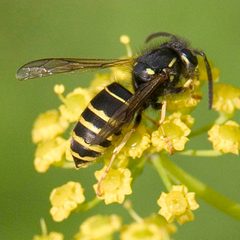
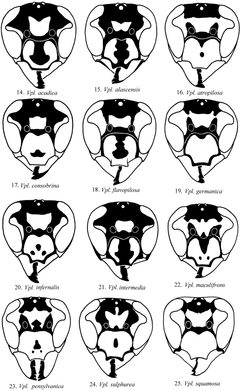
are black with yellow markings and measure 10–15 mm in length. The underside of the scape is yellow rather than completely black, distinguishing it from some . Most reliably separated from the closely related Vespula atropilosa by the shape of the black marking on the second gastral segment: in V. acadica, the apex of the middle black region is rounded, whereas in V. atropilosa it is pointed.
Images
Habitat
Found primarily in forested environments including forests. Nests are built in decaying vegetation such as rotting logs, leaf piles, and other forest floor debris. Occasionally constructs aerial nests, though this is uncommon. Entrance tunnels are typically 15–25 cm long but may extend to 40 cm; the deepest subterranean nest recorded was 15 cm below the surface.
Distribution
North America. Range extends from Alaska down the West Coast to southern California and into the southwestern United States. In the eastern portion of its range, distribution is more northerly through the Great Lakes region and along the East Coast as far south as the Carolinas.
Seasonality
Colony cycle typically begins in mid-July with the onset of reproductive rearing. Most colonies complete their seasonal cycle by the last week of August or first week of September. colonies are founded by single queens in spring and die off in autumn after producing new queens and males.
Diet
Exclusively hunts live prey; does not scavenge from carrion or human food sources. prey on live caterpillars, flies, and hemipterans. are obtained from natural sources. This restricted diet of live prey, rather than scavenging , reduces human encounters compared to other yellowjacket .
Life Cycle
colony cycle with haplometrotic (single ) nest founding. Colonies produce morphologically distinct queens and . Nests contain one worker-rearing comb and one to three reproductive-producing combs. Observed colonies are relatively small, with 75–400 workers and 3–4 combs total. The largest mature colony documented contained 425 workers, 70 males, and 78 queens, with four combs totaling 1,791 . New queens and males are produced in late summer for mating; queens overwinter to found new colonies the following spring.
Behavior
exhibit flexible age and task fixation, with observed including inactivity, , nursing, , defense, and foraging. Mauling—agonistic interactions involving biting of the dorsum of the and —occurs among workers, particularly older individuals during colony decline. Males approach queens from the side to attempt mating, grasping the 's thorax with all six legs; unreceptive queens curl their gaster toward their in a C-shape to prevent copulation. Workers do not thoroughly remove from below the comb, occasionally consuming liquid feces or feeding them to larvae while leaving solids.
Ecological Role
of live arthropods including caterpillars, flies, and hemipterans, contributing to natural pest control in forest . Serves as for the obligate social Vespula austriaca (in Europe) and Vespula infernalis (in North America), which usurp colonies and exploit forces. Nests may host ichneumonids (Sphecophaga cocoons, probably S. vesparum burra) and Fannia spp. on exterior surfaces.
Human Relevance
Limited direct interaction with humans due to forest preference. Not considered a significant pest because it does not scavenge from garbage or picnic areas. When colonies are disturbed, can be aggressive and persistent, delivering repeated stings. Stings are painful and may cause allergic reactions in sensitive individuals.
Similar Taxa
- Vespula atropilosaVery similar black and yellow coloration, but distinguished by the pointed (rather than rounded) apex of the middle black region on the second gastral segment.
- Vespula consobrinaClose relative in the V. rufa group with similar colony and ; morphological separation requires detailed examination.
Sources and further reading
- BugGuide
- Wikipedia
- GBIF taxonomy match
- iNaturalist taxon
- NCBI Taxonomy
- Catalogue of Life
- The Wonderful World of Wasps | Bug Squad
- Portrait of a Yellowjacket | Bug Squad
- Beware of Yellowjacket Nests | Bug Squad
- Surprise visit by a queen: German yellowjacket, Vespula germanica — Bug of the Week
- Fierce Southern Stingers in the DMV: Southern Yellowjackets, Vespula squamosa — Bug of the Week
- Summer stingers – Eastern yellowjackets, Vespula maculifrons — Bug of the Week
- Nesting Biology of a Forest Yellowjacket Vespula acadica (Sladen) (Hymenoptera: Vespidae), in the Pacific Northwest1
- Morphological Comparisons Between the Obligate Social Parasite, Vespula Austriaca(Panzer), and its Host, Vespula Acadica (Sladen) (Hymenoptera: Vespidae)