
Pseudomasaris phaceliae
Rohwer, 1912
Scorpionweed pollen wasp
Pseudomasaris phaceliae is a solitary pollen wasp in the Masarinae, known as the scorpionweed pollen wasp. Like other members of its , it exhibits oligolectic , collecting pollen and nectar from a narrow range of flowering plants to provision its mud nest . The is native to western North America and is one of approximately 14 species in the genus Pseudomasaris, the only masarine genus occurring in North America. Males are distinguished by their elongated, clubbed and engage in behavior to locate females.
Pronunciation
How to pronounce Pseudomasaris phaceliae: //ˌsjuːdoʊməˈsɛərɪs ˌfæsɪˈliːaɪ//
These audio files are automatically generated. While they are not always 100% accurate, they are a good starting point.
Identification
Distinguished from other vespid by the combination of clubbed and absence of a longitudinal body fold when at rest. Males are readily identified by their elongated, clubbed antennae compared to the shorter clubbed antennae of females. Separation from other Pseudomasaris requires examination of morphological details and association with specific plants. The Pseudomasaris is the only masarine genus in North America; other vespid wasps with similar coloration (yellowjackets, paper wasps) have different antennal structure and resting posture.
Images
Appearance
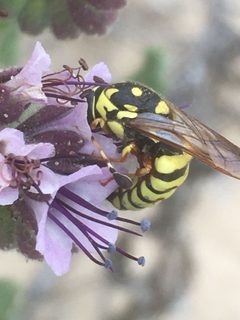
Medium-sized resembling social vespids in general form but with distinctive clubbed . Males possess markedly longer antennae than females, with terminal segments expanded into a club. Body coloration typically involves black and yellow or whitish markings. The Masarinae lacks the longitudinal fold present in other vespid wasps when at rest. is pronounced in antennal length and structure.
Habitat
Arid and semi-arid regions of western North America, associated with flowering plant that provide pollen and nectar resources. Occurs in supporting the plants Phacelia and related in the Hydrophyllaceae, from which the derives its name.
Distribution
Western North America, including regions of the southwestern United States. The Pseudomasaris as a whole ranges from Washington and Wyoming south to California, Arizona, New Mexico, and east to Nebraska and South Dakota; specific range boundaries for P. phaceliae within this region require further documentation.
Seasonality
active during summer months when plants are in bloom. Activity patterns follow flowering of Phacelia and related pollen sources. Males of related have been documented from February through May, with peaks in late June.
Diet
feed on nectar from flowers. Females collect pollen and nectar to provision nest , exhibiting oligolectic specialization on Phacelia and related in Hydrophyllaceae. This pollen-collecting is unique among vespid and convergent with bees.
Host Associations
- Phacelia - pollen sourcePrimary pollen ; epithet derives from this association
- Hydrophyllaceae - pollen source containing Phacelia and related used for pollen collection
Life Cycle
Solitary nesting . Females construct mud nests, typically attached to twigs or other substrates. Each nest contains multiple provisioned with pollen and nectar rather than prey items. An is laid in each cell, and the larva develops on the stored provisions. The nest may be parasitized by cuckoo wasps such as Chrysurissa densa.
Behavior
Females are solitary nest builders, constructing mud nests and provisioning them with pollen and nectar. Males engage in , perching at elevated locations to intercept females. Males of related have been observed maintaining the same perch locations for extended periods (up to 29 days documented in P. maculifrons). The species exhibits oligolectic pollination behavior, visiting a narrow range of flowering plants for pollen collection. are not aggressive and do not defend colonies as social vespids do.
Ecological Role
of Phacelia and related Hydrophyllaceae through its specialized pollen-collecting . As a solitary , it contributes to pollination services in arid western North American . Serves as for parasitic cuckoo wasps. The unique pollen-wasp habit represents an evolutionary convergence with bees within the predominantly predatory wasp lineage.
Human Relevance
Generally harmless to humans; lacks the defensive colony-guarding of social vespids. May be encountered by hikers and naturalists in western North American wildlands during summer months. Of interest to entomologists studying the evolution of pollen-collecting behavior in and the diversification of the Masarinae.
Similar Taxa
- Pseudomasaris vespoidesSimilar and ; distinguished by differences in coloration, distribution, and plant associations (P. vespoides primarily associated with Penstemon)
- Pseudomasaris maculifronsSimilar and male ; differs in distribution and (P. maculifrons active earlier in season, February–May)
- Vespula (yellowjackets) and Polistes (paper wasps)Similar black-and-yellow coloration but distinguished by social , presence of longitudinal fold at rest, and non-clubbed
- Eumeninae (potter and mason wasps)Similar solitary nesting habit but distinguished by prey-provisioning (caterpillars, beetles) rather than pollen-provisioning, and different antennal structure
More Details
Evolutionary significance
The Masarinae represent a remarkable evolutionary transition within the Vespidae, having shifted from the ancestral predatory lifestyle to pollen-collecting convergent with bees. Pseudomasaris phaceliae and its are among the few worldwide that have evolved this habit, making them important subjects for studying the evolutionary origins of eusociality and specialization.
Taxonomic history
The was described by Rohwer in 1912. The Pseudomasaris, established by Ashmead, is the sole representative of the Masarinae in North America. The has a disjunct global distribution, with other genera occurring in South America, Africa, Europe, Asia, and Australia, but absent from tropical regions.
Nesting biology
Unlike most Pseudomasaris that attach nests beneath stones or in sheltered situations, some (such as P. vespoides) attach nests to exposed twigs. The nest structure consists of multiple mud , each provisioned with a pollen-nectar paste and receiving a single .