
Stenodynerus percampanulatus
(Viereck, 1906)
Stenodynerus percampanulatus is a solitary mason wasp in the Eumeninae. The has been synonymized under Rhynchalastor percampanulatus in some taxonomic treatments. Like other Stenodynerus species, it is a cavity-nesting that provisions nests with paralyzed caterpillars as food for its larvae. The is morphologically similar to Parancistrocerus, and the two are often difficult to distinguish in field observations.
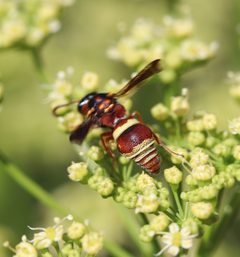
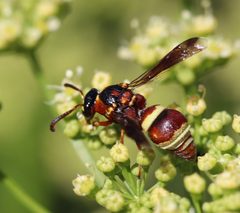
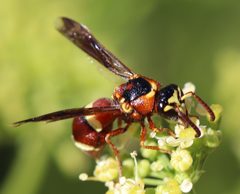
Pronunciation
How to pronounce Stenodynerus percampanulatus: /stɛnoʊˈdaɪnərəs ˌpɜːrkæmpænjuˈleɪtəs/
These audio files are automatically generated. While they are not always 100% accurate, they are a good starting point.
Identification
Stenodynerus percampanulatus is challenging to identify from field observations and is often indistinguishable from Parancistrocerus based on images of live specimens. Even with specimens under a microscope, identification to species level is difficult. The Stenodynerus as a whole can be separated from similar by subtle morphological characters of the propodeum and tergal structure, though these require expert examination.
Images
Habitat
Associated with cavity-nesting including pre-existing tunnels in dead wood, old borings, and hollow twigs. Has been observed in urban and suburban settings where artificial nesting substrates such as blocks are provided.
Distribution
Documented from North America. Specific range details are limited; the type was described by Viereck in 1906. Records exist from Colorado and California based on observational sources.
Seasonality
Active during summer months. Observations from Colorado and California indicate activity in June.
Diet
feed on nectar. Females provision nests with paralyzed caterpillars as food for larval offspring.
Life Cycle
Nests in pre-existing cavities. Females create a series of , each provisioned with paralyzed caterpillars and a single . The larva consumes the provided food and pupates within the cell.
Behavior
Solitary nesting . Females hunt caterpillars, paralyze them with venom, and transport them to nest . have been observed visiting flowers for nectar, including Indian hawthorn (Rhaphiolepsis umbellata).
Ecological Role
of caterpillars, contributing to natural regulation of lepidopteran . As a , may contribute to plant while foraging for nectar.
Human Relevance
Potential beneficial insect in gardens and agricultural settings due to caterpillar . May utilize artificial blocks and nesting structures provided for solitary bees and . Not known to be aggressive toward humans.
Similar Taxa
- Parancistrocerus speciesExtremely similar ; often impossible to distinguish from Stenodynerus in live specimens or photographs. Both are small, ornately patterned mason wasps with similar nesting .
- Euodynerus speciesSimilar size and general appearance as cavity-nesting Eumeninae, though Euodynerus typically has different propodeal structure and facial markings.
More Details
Taxonomic Note
Stenodynerus percampanulatus is treated as a synonym of Rhynchalastor percampanulatus in the Catalogue of Life and GBIF, though iNaturalist and other sources maintain it under Stenodynerus. The Rhynchalastor is sometimes considered a subgenus of Stenodynerus. Taxonomic resolution of this ' placement remains inconsistent across databases.
Identification Challenge
The difficulty in distinguishing Stenodynerus from Parancistrocerus in the field represents a common challenge in Eumeninae . Both contain numerous with subtle morphological differences that require detailed examination of male genitalia, sternal structure, and other microscopic characters.